

India now has 41 million children aged 5-19 with high BMI, making it the second-highest country globally for childhood obesity (World Obesity Atlas, 2026; retrieved 25 May 2026). That's not just a hospital statistic. It starts at the kitchen counter every morning when we pack school lunchboxes.
Here's what makes this harder: India's ultra-processed food market surged from $900 million to $37.9 billion between 2006 and 2019, growing at over 33% annually (Indian Economic Survey 2024-25; retrieved 25 May 2026). Many of the spreads we reach for (jams, chocolate spreads, processed cheese) are quietly loaded with refined sugar, palm oil, and preservatives that children don't need.
We ranked these 9 spreads by three criteria: ingredient transparency (what's actually in it), nutritional value for growing children (protein, vitamins, healthy fats), and FSSAI compliance (alignment with India's school food safety standards). No brand paid for placement. Here's what we found.
Key Takeaways
- Ghee-based spreads, natural nut butters, and homemade chutneys top the list: zero preservatives, real nutrition, and clean ingredient labels.
- Fruit jams can be up to 69% sugar by weight; two tablespoons of Kissan jam exceed WHO's entire daily sugar limit for children (FoodNetIndia, 2024; retrieved 25 May 2026).
- Nutella is 57% sugar. A single serving uses up 84% of a child's daily sugar allowance.
- 80% of Indian children have low Vitamin D levels; fat-soluble vitamins in ghee and white butter can help address this gap (Frontiers in Pediatrics, 2024; retrieved 25 May 2026).
- FSSAI now bans HFSS (high fat, sugar, salt) foods within 50 metres of schools. Your lunchbox choices should match that intent.
1. Why Are Ghee-Based Spreads the Healthiest Choice for Kids?

In 2024, a peer-reviewed study in the Journal of Ayurveda and Integrative Medicine found that ghee contains 3-4% butyric acid, one of the richest dietary sources of this short-chain fatty acid, which fuels gut lining cells and supports immunity (Kataria & Singh, PMC, 2024; retrieved 25 May 2026). For children, that matters because roughly 70% of the immune system resides in the gut.
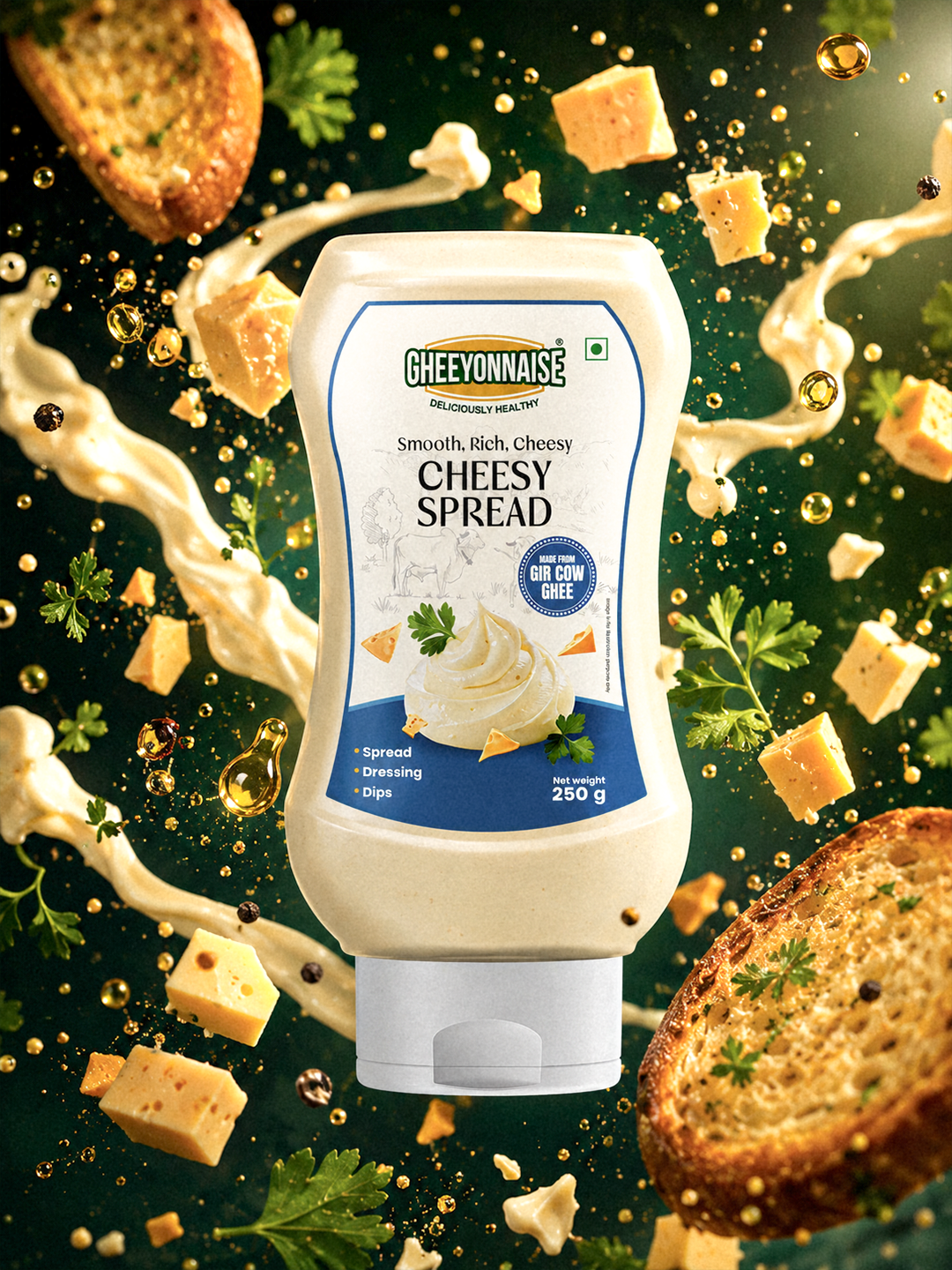
What makes ghee-based spreads stand out isn't just what they contain. It's what they don't. No palm oil, no soya oil, no preservatives, no artificial additives. When we developed Gheeyonnaise, we built it on 100% A2 Gir Cow Ghee because we'd seen three generations of families thrive on this ingredient. The fat-soluble vitamins in ghee (A, D, E, and K2) are exactly what growing children need, especially when studies suggest up to 80% of Indian children have low Vitamin D levels (Frontiers in Pediatrics, 2024; retrieved 25 May 2026).
Best for: Parents who want a daily-use spread with zero red-flag ingredients and real nutritional value. Works on sandwiches, parathas, wraps, and as a dip.
Price range: Rs. 219-279 for 250g. Premium, but justified by the A2 Gir Cow Ghee base instead of cheap refined oils.
It also comes in kid-friendly flavours. The Cheesy Spread is a hit with children who want that familiar cheesy taste without processed cheese preservatives.
2. Are Nut Butters a Good Protein Source for Children?
In 2024, a study in the World Allergy Organization Journal found that peanut allergy prevalence in Indian children is just 0.03%, compared to 1-3% in Western countries, likely because Indian diets introduce peanuts early and often (WAO Journal, 2024; retrieved 25 May 2026). That's reassuring for parents considering nut butters as a lunchbox staple.
Natural peanut butter delivers 7-8g of protein per 30g serving, more than most other spreads on this list. Almond butter adds calcium for bone development. The key word here is "natural": the only ingredient should be roasted nuts. Many commercial brands sneak in hydrogenated oils, added sugar, and palm oil. Always flip the jar and read the label.
Best for: Active children who need sustained energy and protein. Pairs well with banana slices on whole-wheat bread.
Brands to look for: Pintola (natural, no added sugar), Alpino, Yoga Bar. For kids specifically, Jus' Amazin Lil Star uses jaggery instead of refined sugar.
Price range: Peanut butter Rs. 400-750/kg; almond butter Rs. 880-2,000/kg.
Watch out for: If the ingredient list mentions "partially hydrogenated oil" or "sugar" in the first three ingredients, pick a different jar. That's not nut butter. It's a dessert.
3. Can Homemade Chutneys Work as a Lunchbox Spread?

A serving of mint-coriander chutney contains roughly 6 kilocalories while delivering meaningful amounts of Vitamin A, Vitamin C, calcium, and iron, a nutrient density that commercial spreads can't match at any price. The cost? Practically zero. You're using pantry staples: mint, coriander, green chilli, salt, and a squeeze of lemon.
Coconut chutney adds healthy fats and fibre. Peanut chutney bumps up the protein. These are the spreads Indian children have grown up with for generations, and there's a reason they've endured. No preservatives, no artificial colours, no hidden sugars. Just real food.
Best for: Budget-conscious families; children who eat rotis, idlis, or dosas in their tiffin.
Price range: Negligible (homemade from pantry ingredients).
The convenience tradeoff: Shelf life is the honest drawback. Homemade chutneys last 1-2 days refrigerated. A practical hack: blend a batch, freeze in ice cube trays, and pop one into the lunchbox each morning. It thaws by lunch break.
Our finding: When we tested lunchbox-friendly spreads internally at Riks Global Foods, homemade pudina chutney consistently ranked in the top 3 for taste among children aged 6-12, right alongside cheesy spreads and peanut butter.
4. Is White Butter (Makhan) Healthy for Growing Children?
In 2024, Kataria and Singh's peer-reviewed analysis found that ghee and butter appeared in 774 therapeutic mentions across 11 Ayurvedic texts spanning 3,000 years, the highest frequency among all milk products (PubMed, 2024; retrieved 25 May 2026). Modern science backs this up. White butter is rich in arachidonic acid, which is critical for brain development in children. A baby's brain is 60% fat, and the saturated fats in makhan help build myelin sheaths, the protective coating around nerve fibres.
Homemade white butter has exactly one ingredient: cream from whole milk, churned. No preservatives. No colouring. No emulsifiers. The A2 variant (from Gir cow milk) contains higher omega-3 and beta-carotene levels.
Best for: Toddlers and young children who need calorie-dense, brain-building fats. Spread it on a warm paratha. That's a complete meal.
Price range: Homemade from curd costs almost nothing. Commercial A2 makhan: Rs. 250-500 for 200g.
Limitation: White butter doesn't have the flavour range of a condiment. It's a fat, not a spread in the sandwich-mayo sense. Best combined with other fillings rather than used alone.
5. Is Hummus a Good Spread for Kids in India?
India's kids' food and beverage market is projected to reach USD 15.5 billion by 2031, growing at 8.1% CAGR, with clean-label now a mainstream requirement (Knowledge Sourcing Intelligence, 2025; retrieved 25 May 2026). Hummus fits that clean-label trend: plant-based protein and dietary fibre from chickpeas, paired with calcium from tahini and healthy fats from olive oil. For families raising vegetarian children, hummus adds variety beyond the standard butter-cheese-jam rotation.
India's hummus market is still niche, but brands like Wingreens Farms, Earthy Bliss, and Natuf are making it accessible in metro cities. A few Indian brands now offer preservative-free versions that compete with homemade.
Best for: Children who enjoy milder international flavours. Works well as a dip with carrot sticks or as a sandwich spread.
Price range: Rs. 180-450 per pack (150-200g).
The honest limitation: Availability drops sharply outside metros. Cold-chain requirements make hummus impractical in many tier-2 and tier-3 towns. If you can't find it locally, homemade hummus from boiled chickpeas, tahini, and olive oil takes 10 minutes in a mixer.
6. Natural Cream Cheese — Best for Calcium
In 2024, a study in Frontiers in Pediatrics found that 21.5% of children aged 1-6 showed growth retardation linked to low fat-soluble vitamin intake, with calcium deficiency a key contributor (Yan et al., 2024; retrieved 25 May 2026). Cream cheese delivers roughly 4.5g of protein per serving along with calcium, both essential for growing bones and teeth. The category has evolved beyond imported Philadelphia tubs. Indian brands like Epigamia (Greek-style, higher protein), Dairy Craft (farm-fresh, no additives), and Mooz (100% natural) now offer cleaner options.
The important distinction: natural cream cheese versus processed cheese spread (which we'll get to next). Natural cream cheese has a simpler ingredient list: milk, cream, salt, cultures. No emulsifying salts, no Class II preservatives.
Best for: Children who enjoy a mild, creamy taste on bagels, crackers, or sandwiches.
Price range: Rs. 145-500+ depending on brand (premium artisanal brands run higher).
Practical concern: Cold chain is non-negotiable. Cream cheese spoils quickly in Indian summer heat, and availability drops sharply outside metros. Not ideal as a daily lunchbox spread unless you have refrigeration until the morning pack.
7. Processed Cheese Spreads — Proceed with Caution
Amul Cheese Spread contains 840mg of sodium per 100g and includes Class II preservatives E200 (sorbic acid) and E234 (nisin), along with emulsifying salts E339, E452, E471, and E331 (FoodNetIndia, 2024; retrieved 25 May 2026). FoodNetIndia rated it 5 out of 10 for both safety and wholesomeness. That doesn't make it poison, but it's not the "healthy calcium source" that marketing suggests.
ICMR-NIN recommends a maximum of 2,000mg sodium per day for adults, with downward adjustments for children (ICMR-NIN RDA, 2020; retrieved 25 May 2026). A 40g serving of Amul Cheese Spread (roughly what a child uses on two slices of bread) delivers 336mg of sodium before you've added anything else to the meal.
Verdict: Occasional use is fine. Daily lunchbox staple? There are better options higher on this list. If your child loves cheese, consider natural paneer spread or cottage cheese mashed with herbs — same taste appeal, a fraction of the sodium.
Price range: Rs. 94-115 for 200g (very affordable, which drives daily usage).
8. How Much Sugar Is Really in Your Child's Jam?
Kissan Mixed Fruit Jam, India's most popular jam brand, is approximately 69% sugar by weight, with 13.8g of sugar in a 20g serving (FoodNetIndia, 2024; retrieved 25 May 2026). FoodNetIndia rated it 3 out of 10 for safety. Here's what that means in practical terms: two tablespoons of jam (about 40g) gives a child approximately 27g of sugar, exceeding WHO's entire recommended daily limit of 25g for children.
It gets worse when you read the full label. Sugar is the first ingredient, listed above fruit. Many Indian jams also contain artificial colours (Permitted Synthetic Food Colour 122 / Azorubine, which has been linked to respiratory issues in children) and preservatives (E202 / Potassium Sorbate).
Does this mean all jam is off limits? Not necessarily. Premium brands like Orchard Lane (80% fruit, no preservatives) and Eatopia (honey-based, no added sugar) offer dramatically cleaner options, though at Rs. 200-400 versus Rs. 80-130 for mass-market jams.
Verdict: If it's the first ingredient on the label, it's a sugar delivery system, not a fruit product. Switch to natural alternatives or reserve jam for occasional weekend treats.
If you're trying to make sense of ingredient labels, our guide on why palm oil in mayo should concern you walks through how to spot red-flag ingredients on any packaged food.
9. Why Are Chocolate Spreads the Worst Lunchbox Choice?
In 2016, the European Food Safety Authority found that palm oil, the second ingredient in Nutella, generates the highest levels of process contaminants (glycidyl esters, 3-MCPD) among all vegetable oils, and flagged these as "a particular concern for younger age groups" who consume the most relative to body weight (EFSA, 2016; retrieved 25 May 2026). Nutella is also 57% sugar. A single 37g serving contains 21g of sugar, consuming 84% of WHO's 25g daily limit for children.
Despite the hazelnut marketing, hazelnuts make up only 13% of the product. What you're actually spreading on your child's bread is refined sugar with palm oil, dusted with cocoa and a handful of nuts.
Verdict: Treat it like what it is: a dessert, not a breakfast staple. If your child loves the chocolate-hazelnut taste, Indian brands like The Butternut Co. (no refined sugar, vegan) and Happy Jars (jaggery-sweetened) offer versions without the worst offending ingredients.
Price range: Nutella Rs. 270-799 for 350g; healthier Indian alternatives Rs. 200-500 for 200g.

The Comparison at a Glance
| Spread | Added Sugar | Palm Oil | Preservatives | Protein | Price (250g) | Verdict |
|---|---|---|---|---|---|---|
| Ghee-Based Spread | None | No | No | Low | Rs. 219-279 | Daily use |
| Natural Nut Butter | 0-1g | No* | No | 7-8g | Rs. 100-190 | Daily use |
| Homemade Chutney | None | No | No | Low | Negligible | Daily use |
| White Butter | None | No | No | Trace | Rs. 250-500 | Daily use |
| Hummus | 0-1g | No | No* | 2-3g | Rs. 200-500 | Daily use |
| Natural Cream Cheese | 0-1g | No | No | 4-5g | Rs. 200-600 | Good option |
| Processed Cheese Spread | ~1g | No | Yes | 3-4g | Rs. 94-115 | Occasional |
| Fruit Jam | 13.8g | No | Yes | 0g | Rs. 80-130 | Avoid daily |
| Chocolate Spread | 21g | Yes | No | 2g | Rs. 200-570 | Avoid daily |
*Check labels — some commercial brands add palm oil or preservatives. "No" indicates the natural/homemade version.
How Did We Rank These Spreads?
We evaluated 12 spread categories commonly available in India and narrowed to these 9 based on relevance for children's lunchboxes. Each was scored on three criteria:
- Ingredient transparency: How many additives, preservatives, artificial colours, and refined oils does the ingredient list contain? Fewer is better.
- Nutritional value for children: Does it deliver protein, healthy fats, fat-soluble vitamins, or fibre that growing bodies need? Or is it mostly empty calories?
- FSSAI alignment: Would this product pass FSSAI's own school food safety standards, which ban HFSS foods in school premises?
No brand on this list paid for placement. We make one of the products listed (the ghee-based spread at #1) and we're transparent about that, but the nutritional data and ingredient comparisons are independently verifiable. We encourage you to flip the jar and read the label yourself. Our ranking criteria come from nearly two decades of working with ghee and dairy. You can read more about our story and Kehul Shah's journey at Riks Global Foods.
Frequently Asked Questions
What is the healthiest spread for a child's school sandwich?
Ghee-based spreads and natural nut butters top the list. Both offer zero preservatives and real nutritional value: butyric acid and fat-soluble vitamins from ghee, or 7-8g protein per serving from peanut butter. The key is checking the ingredient label: fewer ingredients generally means a cleaner product.
Are nut butters safe for Indian children given allergy concerns?
Peanut allergy prevalence in Indian children is just 0.03% — compared to 1-3% in Western countries, likely because Indian diets introduce peanuts early (World Allergy Organization Journal, 2024; retrieved 25 May 2026). Still, introduce any new food gradually and watch for reactions, especially with children under 3.
Why should parents avoid palm oil in kids' food?
The European Food Safety Authority found that palm oil generates the highest levels of process contaminants (glycidyl esters) among vegetable oils, calling them "a particular concern for younger age groups" (EFSA, 2016; retrieved 25 May 2026). Palm oil is the second ingredient in Nutella and a primary oil in most commercial mayonnaises sold in India. For a deeper look at how to decode packaged food labels, see our guide on reading condiment labels in India.
How much sugar per day is safe for children?
WHO recommends fewer than 25 grams (6 teaspoons) of free sugars per day for children. A single serving of Nutella (37g) delivers 21g. That's 84% of the entire daily limit before your child eats anything else. Fruit jams aren't much better: two tablespoons of Kissan jam exceed 25g.
Is ghee-based mayo healthier than regular mayo?
Regular mayonnaise typically uses refined soyabean oil or palm oil as its base, along with preservatives like EDTA and potassium sorbate. Ghee-based mayo like Gheeyonnaise Classic Spread replaces those with A2 Gir Cow Ghee, delivering butyric acid, fat-soluble vitamins, and a cleaner ingredient list. For the full comparison, read our piece on what science says about ghee in 2026.
The Bottom Line
Your child's lunchbox spread is a daily decision, and daily decisions compound. The top five on this list (ghee-based spreads, natural nut butters, homemade chutneys, white butter, and hummus) all share something in common: short ingredient lists with real, recognisable food. The bottom three share the opposite: refined sugar as a primary ingredient, industrial preservatives, and ingredients you'd need a chemistry degree to pronounce.
The simplest rule? Flip the jar. If sugar or palm oil appears in the first three ingredients, put it back. Your child's gut, brain, and bones will thank you for the switch.
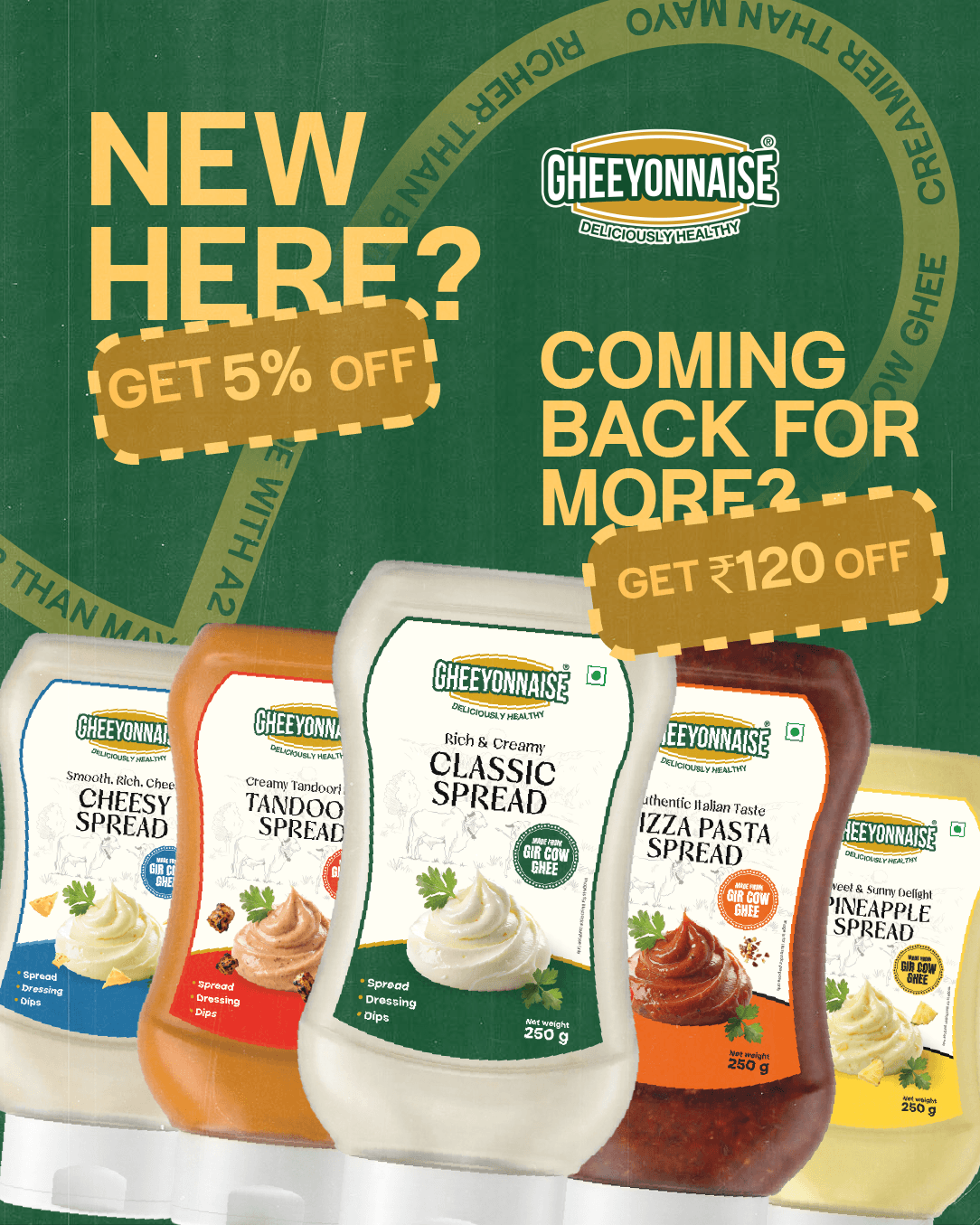
Ready to try the clean-label alternative? Explore all five Gheeyonnaise flavours, each one made with 100% A2 Gir Cow Ghee, zero palm oil, and zero preservatives.
0 comments