

India has 101 million people living with diabetes and another 136 million with prediabetes. That's according to the ICMR-INDIAB study of over 121,000 participants across all 31 states (ICMR-INDIAB / PIB India, 2023). Yet the ketchup sitting on most Indian dining tables is 20–25% sugar by weight. That's one-fifth sugar — and most people have no idea.
Here's the uncomfortable truth. In 2024, a study of 1,832 supermarket shoppers in Delhi and Hyderabad found that while 90% claimed to read food labels, only 33% actually checked the ingredients list or nutritional information. The overwhelming majority — 81% — looked only at the manufacturing date and expiry date (Public Health Nutrition, PMC, 2024).
Do you know what the first ingredient in your mayo actually is? We're not reading the parts that matter. And condiments, the sauces, spreads, and dips we add to nearly every meal, are where the worst surprises hide. This guide walks you through exactly what to look for on a condiment label in India. Five steps. No jargon. No guesswork.
Key Takeaways
- 81% of Indian shoppers check only expiry dates on food labels, skipping ingredients and nutrition information entirely (Public Health Nutrition, 2024).
- Most commercial mayo in India lists refined soybean oil as the #1 ingredient — making up roughly 45–50% by weight.
- Standard tomato ketchup contains 20–25% sugar. Indian brands tested ranged from 16g to 30g of sugar per 100g.
- FSSAI requires ingredients to be listed in descending order by weight — the first three ingredients tell you what you're mostly eating.
Why Reading Condiment Labels Matters Right Now
India's packaged food market hit USD 129.18 billion in 2025 and is on track for USD 238.83 billion by 2034 (IMARC Group, India Packaged Food Market Report, 2025). That's a lot more products on shelves. More brands competing for your attention. And more chances for manufacturers to slip cheap ingredients behind reassuring packaging.
India still doesn't have mandatory front-of-pack warning labels. The Supreme Court has been pushing FSSAI to finalise front-of-pack labelling (FOPL) since 2014. As recently as February 2026, the court directed FSSAI to respond within four weeks on mandatory warning labels for high sugar, fat, and sodium (Business Standard, 2026). After twelve years of deliberation, there's still no system in place.
Until front-of-pack warnings arrive, the only defence you have is knowing how to read the back of the pack. Condiments are a good place to start — they're in every Indian kitchen, consumed daily, and often assumed to be harmless "small additions" to food. They're not always small, and they're not always harmless.
Step 1: Read the Ingredients List First (Not the Nutrition Panel)
By the end of this step, you'll know what your condiment is actually made of — and you'll never look at labels the same way again.
FSSAI regulations require every ingredient to be listed in descending order by weight. The first ingredient makes up the largest proportion of the product. The second makes up the next largest. And so on. This single rule is the most powerful tool you have as a consumer.
Here's what it reveals in practice. Pick up a jar of a popular commercial mayonnaise in India. The first ingredient is almost certainly "Refined Soyabean Oil" — not eggs, not any kind of quality fat. Soybean oil makes up roughly 45–50% of most commercial mayo by weight. The second ingredient is typically water. So the product you thought was a creamy, premium spread is mostly refined oil and water.

The three-ingredient rule: The first three ingredients typically make up 70–80% of the product. If those three are refined oil, water, and sugar — you know what you're paying for.
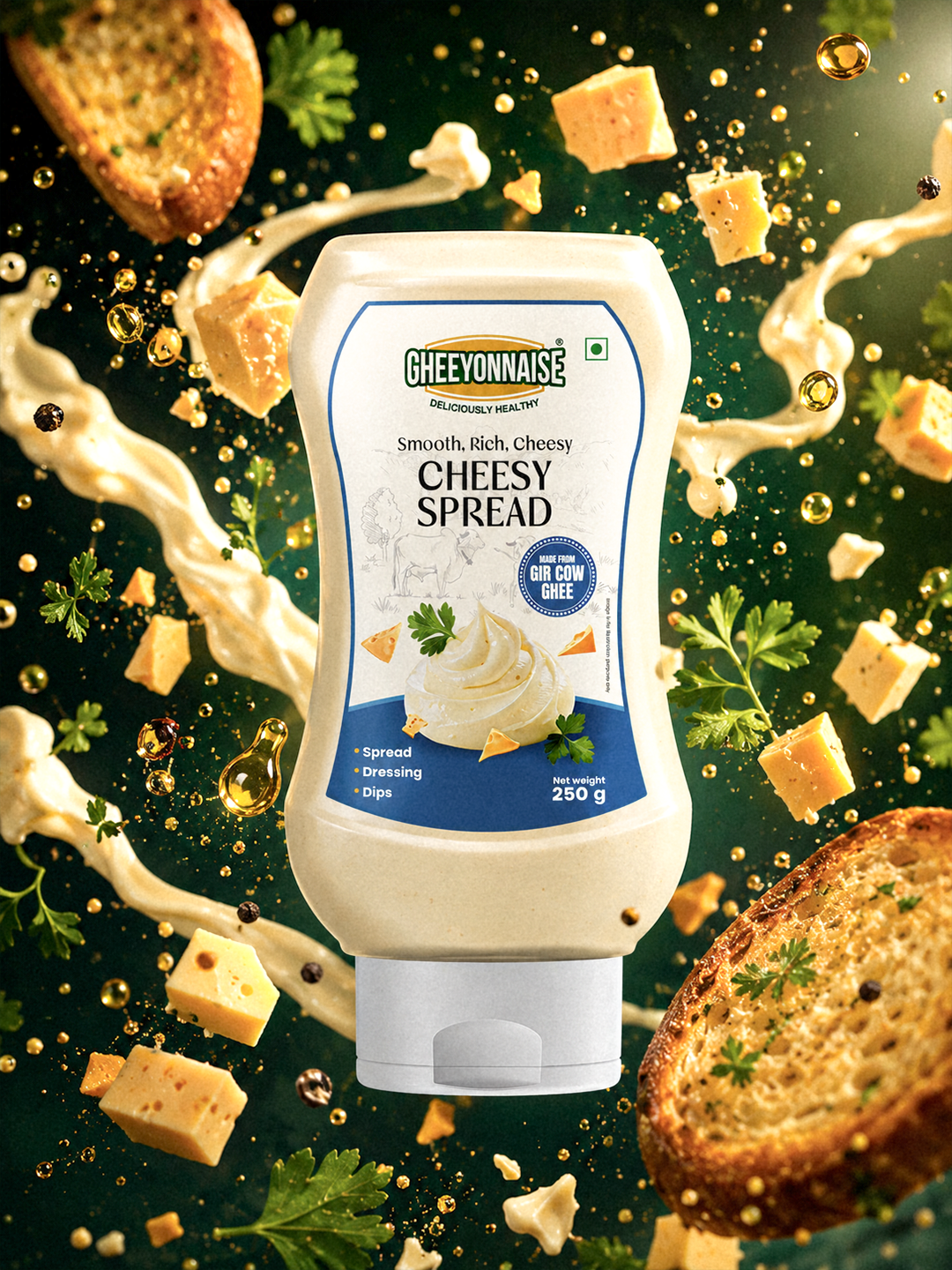
Compare that to a clean-label alternative. Our Gheeyonnaise Classic Spread lists A2 Gir Cow Ghee as the primary fat — no refined soybean oil, no palm oil. The ingredients list tells you everything about a product's priorities.
Step 2: Spot the Oils — What's Really in Your Spread?
Pick up any condiment in an Indian supermarket and flip it over. Odds are, the oil inside isn't what you'd expect. Palm oil alone accounts for 38-40% of India's total edible oil consumption, with 8.9 million metric tonnes imported every year (IMARC Group / USDA, India Palm Oil Market, 2025). It's cheap, it's everywhere, and it rarely shows up on the front label. For a deeper look at why palm oil in mayo should concern you, we've written a full breakdown.
Condiment labels use several names for oils. Here's what to watch for:
| Label Name | What It Actually Is | Watch Out? |
|---|---|---|
| Refined Soyabean Oil | Solvent-extracted, high omega-6 polyunsaturated oil | Yes |
| Edible Vegetable Oil (Palm) / Palmolein | Palm oil — high saturated fat, environmental concerns | Yes |
| "Edible Vegetable Oil" | Generic — could be any oil (often palm or soy blend) | Yes — vague |
| Olive Oil / Extra Virgin Olive Oil | Cold-pressed, higher in monounsaturated fats | Better option |
| Ghee / A2 Cow Ghee | Traditional fat, rich in butyric acid and fat-soluble vitamins | Clean choice |
The vaguest label to watch for? "Edible Vegetable Oil" without specifying the type. FSSAI requires manufacturers to name the specific oil, but some still use this catch-all phrase. If you see it, the product is likely using the cheapest available oil — usually palm or soybean.
What we learned as manufacturers: The oil a company chooses for its condiment tells you everything about its priorities. Refined soybean oil costs a fraction of A2 cow ghee. When a brand chooses the premium ingredient despite the cost, it's a signal that quality comes before margin. That's a philosophy, not just a recipe.
Step 3: Decode the Hidden Sugar
Here's a number that shocks most people: standard tomato ketchup is 20-25% sugar by weight. One-fifth sugar. Indian brands tested in a consumer study ranged from 16.37g to 30.13g of sugar per 100g. After public advocacy by food label activist Revant Himatsingka (FoodPharmer), Maggi ketchup reduced its sugar content by 22% in 2024 (The Better India, FoodPharmer impact on food label awareness, 2024). That's progress, but the baseline was terrible.
Sugar hides behind many names on Indian labels. Watch for these:
- Sugar — the obvious one, but check where it appears in the ingredient order
- Dextrose — a simple sugar derived from corn or wheat starch
- Maltodextrin — a processed starch that spikes blood sugar rapidly
- Invert syrup / Liquid glucose — refined sugar in liquid form
- Corn syrup / High fructose corn syrup — common in imported sauces

The quick check: Look at "Total Sugars" on the nutritional panel. Anything above 5g per serving in a savoury condiment is worth questioning. If sugar appears in the first three ingredients of a savoury product, that's a red flag.
Step 4: Crack the Preservative Codes (INS Numbers)
Ever flipped a ketchup bottle and seen "INS 211" in the ingredient list? Most people skim right past it. India's food preservatives market reached USD 103.90 million in 2024 (IMARC Group, India Food Preservatives Market, 2024), and FSSAI classifies these additives into two classes. Condiment labels are full of them.
Those cryptic "INS" numbers on your ketchup bottle? They're International Numbering System codes for food additives. Here are the ones you'll find on almost every condiment label in India:
| INS Code | Actual Name | Function | Found In |
|---|---|---|---|
| INS 211 | Sodium Benzoate | Preservative (Class II) | Ketchup, mayo, sauces |
| INS 202 | Potassium Sorbate | Preservative (Class II) | Mayo, dressings, chutneys |
| INS 319 | TBHQ | Synthetic antioxidant | Oil-based mayo, sauces |
| INS 1442 | Modified Starch | Thickener/stabiliser | Mayo, sauces, dressings |
| INS 621 | MSG (Monosodium Glutamate) | Flavour enhancer | Chinese sauces, seasonings |
| INS 102 | Tartrazine | Artificial colour (yellow) | Coloured sauces, some pickles |
For the full official list of INS codes and food additive classifications, FSSAI maintains a consumer-friendly label reading guide on their Eat Right India portal.

The simple rule: Count the INS codes on a condiment label. If there are more than three, the product relies heavily on additives. A truly clean-label condiment shouldn't need synthetic preservatives, artificial colours, or chemical thickeners.
For context: a popular commercial veg mayo in India lists Preservatives (INS 211, INS 202), Antioxidant (INS 319/TBHQ), Emulsifiers (INS 415, INS 1442), and Acidity Regulators (INS 260, INS 330). That's six additive categories in a single product. The ingredient list should make you pause.
Step 5: Use the Nutritional Panel as Your Scorecard
The nutritional panel is the scorecard most people ignore. Yet 64% of Indian consumers now say they want detailed product information before buying anything (NielsenIQ, Global State of Health & Wellness, 2025). The demand for transparency is there. The skills to use it? Not quite.
FSSAI mandates that the nutritional panel show values per 100g (or 100ml). This is your comparison tool. When you're choosing between two condiments, ignore the brand name and compare these four numbers:
- Total fat and saturated fat -- What kind of fat, and how much? Saturated fat from ghee behaves differently in your body than saturated fat from palm oil. The label won't tell you that. Cross-reference with the ingredients list.
- Total sugars and added sugars -- FSSAI now requires "added sugars" to be listed separately. This is the number that matters in savoury condiments. Any added sugar in your mayo or mustard? Worth questioning.
- Sodium -- Condiments are a major hidden source of dietary salt. One tablespoon of soy sauce can contain over 900 mg of sodium. That's nearly half the daily recommended limit.
- Trans fat -- FSSAI capped trans fat at 2% of total fat content as of January 2022, down from 5% (FSSAI, Trans Fat Notification, 2022). See anything above 0%? That means partially hydrogenated oils were used in processing.
Quick comparison tip: Always compare on a "per 100g" basis, not "per serving." Manufacturers set their own serving sizes to make numbers look better. We've seen mayo brands list a serving as 10g (two teaspoons), making 500 kcal per 100g look like just 50 kcal per serving. Per 100g keeps the playing field level.
Common Mistakes When Reading Condiment Labels
Reading a label and understanding it are two very different things. How different? A 14-state survey of 2,024 Indian respondents found that 55.4% still perceived packaged foods as healthy even after reading labels (Bhattacharya et al., Frontiers in Public Health, 2022). Here are the mistakes we see most often.
1. Trusting "No Preservatives" claims without checking. Some brands claim "no added preservatives" on the front, but the ingredient list tells a different story. FSSAI considers certain additives as "processing aids" rather than preservatives, creating a grey area. Always verify by reading the back label.
2. Ignoring the ingredient order. Most consumers treat the ingredients list as a block of text and skip it. The order is the information. If sugar appears before tomatoes in your ketchup, there's more sugar than tomato. That single insight changes everything.
3. Comparing brands on price instead of per-100g nutrition. A cheaper condiment might cost less per jar — but if it's mostly water, refined oil, and sugar, you're not saving money. You're just buying more of the wrong things. Compare the cost per gram of actual nutrition, not per gram of product.
4. Assuming "vegetarian" means "healthy." The green dot on Indian packaging means the product contains no animal-derived ingredients. It says nothing about nutritional quality. A product can be vegetarian and still be loaded with refined oils, sugar, and synthetic preservatives.
5. Overlooking sodium in "small" condiment servings. Nobody uses just one teaspoon of ketchup. In practice, most people consume 2–3 tablespoons per sitting. Multiply the per-serving sodium by three, and suddenly that "low sodium" condiment is contributing significantly to your daily intake.
Frequently Asked Questions
What are the mandatory items on a food label in India?
FSSAI requires 15+ elements including: product name, ingredients in descending order by weight, nutritional information per 100g, allergen declaration, FSSAI logo and 14-digit license number, veg/non-veg symbol, net quantity, manufacturer details, date markings (best before/expiry), batch number, and MRP. Recent amendments mandate that sugar, salt, and saturated fat values appear in bold and larger font sizes.
How much sugar is in tomato ketchup?
Standard tomato ketchup contains 20–25% sugar by weight. Indian brands tested in a consumer study ranged from 16.37g to 30.13g of sugar per 100g. That's roughly 5 grams of sugar per tablespoon — comparable to a biscuit. After public pressure, Maggi ketchup reduced its sugar content by 22% in 2024.
What does INS 211 mean on food labels?
INS 211 is the International Numbering System code for Sodium Benzoate, a Class II synthetic preservative commonly used in ketchup, mayo, sauces, and chutneys. FSSAI requires it to be declared on labels. It prevents bacterial and fungal growth but has been linked in some research to oxidative stress. Products without INS 211 exist — they typically use natural preservation methods or shorter shelf lives.
Is palm oil bad in food products?
Palm oil accounts for 38-40% of India's edible oil consumption. It's high in saturated fat (about 50%) and contains no butyric acid or CLA, both found in ghee. Environmentally, palm oil farming drives deforestation. On labels, look for "Edible Vegetable Oil (Palm)" or "Palmolein." Many condiments use it because it's the cheapest available fat.
How can I tell if a condiment is genuinely clean-label?
A genuinely clean-label condiment has a short ingredients list (under 8 items), names every ingredient in plain language (no INS codes needed), uses no synthetic preservatives or artificial colours, and lists a recognisable fat source like ghee or olive oil as its primary ingredient — not "edible vegetable oil." India's clean-label ingredients market is valued at USD 2.43 billion in 2025 and growing at 9%+ CAGR, reflecting real consumer demand.
Start Reading Labels Today
You don't need a nutrition degree to read a condiment label. You need five minutes and the willingness to turn the bottle around. Check the first three ingredients. Count the INS codes. Compare sugar per 100g. That's it — three checks that take less time than deciding which ketchup to buy.
India's packaged food market is doubling in the next decade. More products will fight for your kitchen shelf. The label is the only honest thing on the packaging — it can't lie. Everything else — the branding, the health claims on the front, the celebrity endorsements — is marketing. The back of the pack is the truth.
If you're looking for condiments that pass the label test, explore all five Gheeyonnaise spreads — each made with 100% A2 Gir Cow Ghee, no palm oil, no soya oil, and no preservatives. Or read about what science says about ghee's health benefits in 2026 for the full nutritional picture.
Got questions about food labels, ingredients, or what goes into our products? Write to us at gheeyonnaise@riksglobal.com.
— Kehul Shah, Founder, Gheeyonnaise
Updated May 2026

0 comments