

In 2024, researchers Deepshikha Kataria and Gurmeet Singh published a landmark review in the Journal of Ayurveda and Integrative Medicine. They combed through 4,000 references to ghee across classical Ayurvedic texts and modern PubMed studies. The result? 774 distinct therapeutic claims for ghee, covering gut health, brain function, and wound healing (Kataria & Singh, NCBI PMC, 2024).
That's a lot of claims. But how many hold up under modern science?
Indian kitchens have trusted ghee for over 3,000 years. Yet for decades, nutritionists warned against it. Too much saturated fat, they said. Now the pendulum has swung back. Ghee sits on superfood lists, health influencers swear by it, and India's A2 ghee market is growing at 22.3% annually. So who's right?
We reviewed the latest peer-reviewed evidence, published between 2019 and 2024, on ghee's nutritional profile, gut health benefits, cooking safety, and the one area where scientists still disagree. Here's what the data shows.
Key Takeaways
- Ghee contains 3 to 4% butyric acid, the richest dietary source of this gut-supporting short-chain fatty acid (Kataria & Singh, 2024).
- At 485°F, ghee's smoke point beats butter (350°F), EVOO (320°F), and coconut oil (350°F), making it safer for Indian high-heat cooking.
- Lactose content in ghee is nearly zero: <0.05 to 2.9 mg/100g versus 685 mg in butter (PMC5471386, 2017).
- Heart health evidence remains mixed. Moderation (1 to 2 tablespoons daily) is the scientific consensus.

What Does Ghee Actually Contain? A Nutritional Breakdown
In 2024, Kataria and Singh's peer-reviewed analysis in the Journal of Ayurveda and Integrative Medicine found that ghee is 99.5% fat with less than 0.5% moisture. It carries 28.21 IU/g of vitamin A and 31.55 IU/g of vitamin E (Kataria & Singh, Health benefits of ghee, 2024). Per tablespoon, that means roughly 120 calories, 14 grams of total fat, and 8% of your daily vitamin A.
But it's the fat profile that makes ghee stand out. Unlike refined vegetable oils that are mostly long-chain fats, ghee carries a mix of short-chain, medium-chain, and long-chain fatty acids. That mix matters.
| Nutrient | Per Tablespoon (14g) | % Daily Value |
|---|---|---|
| Calories | 120 kcal | 6% |
| Total Fat | 14g | 18% |
| Saturated Fat | 9g (62%) | 45% |
| Vitamin A | 395 IU | 8% |
| Vitamin E | 0.4 mg | 2% |
| Vitamin K2 | 1.2 mcg | 1% |
| Butyric Acid | ~0.5g (3-4%) | N/A |
| CLA | ~0.11g (0.8%) | N/A |
Sources: USDA FoodData Central; Kataria & Singh (2024)
Here's what stands out. That 28% monounsaturated fat? It's mostly oleic acid, the same heart-friendly fat in olive oil. The 6% short-chain fatty acids include butyric acid, which we'll cover next. And the 0.8% CLA (conjugated linoleic acid) is a natural fat linked to anti-inflammatory benefits in early research.
One tablespoon of ghee also gives you vitamin K2. The amounts are modest: 8.6 mcg per 100g, or about 11% of daily value. But K2 is rare in modern diets. It helps direct calcium to your bones instead of your arteries.
Worth noting: Grass-fed and A2 cow ghee contains 3 to 5 times more fat-soluble vitamins than grain-fed ghee. The animal's diet directly shapes the nutrition in your ghee. At Gheeyonnaise, we use 100% A2 Gir Cow Ghee for this reason. Three generations of ghee-making taught us that the source matters more than the process.

Does Butyric Acid in Ghee Actually Improve Gut Health?
In 2024, the Kataria and Singh review confirmed that cow ghee contains 3.17 plus or minus 0.78% butyric acid. That makes it the richest natural dietary source of this short-chain fatty acid (Kataria & Singh, Health benefits of ghee, 2024). Butyric acid isn't just another nutrient. It's the main fuel for the cells lining your colon.
Why does that matter? Your gut lining replaces itself every 3 to 5 days. Those colon cells need butyric acid to power that renewal. When butyrate levels drop, the gut lining weakens. Toxins and undigested food particles can pass through, a condition often called "leaky gut."
A 2024 study in Food Science & Nutrition (Wiley) confirmed that butter and ghee contain butyric acid at roughly 3 to 4% of total fatty acids. That's higher than all other natural food fats (Mohammadi-Nasrabadi et al., 2024). Buffalo ghee shows even higher levels at 4.06%.
Our experience: When we developed Gheeyonnaise, we tested multiple ghee sources before settling on A2 Gir Cow Ghee. The butyric acid in Gir cow ghee consistently tested higher than in commercial butter-derived ghee. This aligns with research showing indigenous breeds produce milk with a richer short-chain fatty acid profile.
What does this mean in practice? A single tablespoon of ghee delivers a real dose of butyric acid to your gut. You don't need supplements or fermented foods alone. The traditional Indian practice of adding a spoon of ghee to dal or rice has a biochemical basis. It's also why we built our Classic Spread on an A2 Gir Cow Ghee base -- to carry these gut-friendly short-chain fatty acids into everyday meals like sandwiches and parathas.
Ghee is a concentrated source of butyric acid (3 to 4% of total fatty acids), the primary energy source for colon cells. According to Kataria and Singh's 2024 review, 18.73% of ghee's 774 classical therapeutic references specifically address gut health. That makes digestive support ghee's second most cited traditional benefit, after brain function.
But here's a caveat. Most butyrate research uses isolated supplements at higher doses than you'd get from food. The gut health benefits of dietary butyric acid from ghee are supported by traditional use and emerging research. However, large-scale clinical trials on ghee and gut outcomes are still needed.

Why Does Ghee's Smoke Point Matter for Indian Cooking?
In 2026, ghee's smoke point of 485°F (252°C) makes it the most heat-stable common cooking fat. It outperforms olive oil at 450°F, coconut oil at 350°F, and butter at just 302 to 350°F (vom Fass, Smoke Point of Oils Chart, 2026). For Indian cooking, where tadka, deep frying, and high-heat roasting are daily techniques, this gap matters.
What happens when a cooking fat goes past its smoke point? It breaks down into free radicals and harmful compounds like acrolein. These don't just ruin flavour. Repeated exposure to oxidised cooking oils is linked to higher inflammation.
Ghee handles heat so well because of its clarification process. When butter is slowly heated, the milk solids (proteins, lactose, and water) separate and get removed. What remains is pure butterfat. Those milk solids are exactly what causes butter to burn at lower temperatures. Remove them, and the fat's heat tolerance jumps by over 130°F.
This matters beyond taste. When you make tadka in extra virgin olive oil at 425°F, you're already above its smoke point. Switch to ghee, and you've got a 60°F safety margin. For anyone doing daily Indian cooking (tempering spices, shallow frying parathas, roasting vegetables), ghee is simply the safer choice. Try pairing a ghee-based tadka with our Tandoori Spread on the side -- the smoky spice profile was designed for exactly this kind of Indian meal.
Ghee's 485°F smoke point makes it the most heat-stable common cooking fat, beating olive oil by 35°F and butter by 135°F. The clarification process removes milk solids that cause low-temperature burning. This makes ghee especially suited for Indian high-heat cooking like tadka and deep frying, where other oils would oxidise and produce harmful free radicals.
Is Ghee Safe for People with Lactose Intolerance?
In 2017, a peer-reviewed analysis in BMC Nutrition measured lactose in common dairy fats. The finding: ghee contains just <0.05 to 2.9 mg of lactose per 100g, compared to 685 to 688 mg per 100g in butter. That's a reduction of over 99% (Parr et al., The lactose and galactose content of milk fats, PMC5471386, 2017).
How is this possible? During clarification, butter is heated slowly until the water evaporates and milk solids sink. Those solids contain virtually all the lactose and casein (milk protein). Skim them off, and what's left is pure fat with almost no lactose.
For the roughly 68% of the world's population with some degree of lactose trouble, this is big news. Most people with lactose intolerance can consume ghee without symptoms. The near-complete removal of lactose and milk proteins during clarification makes ghee one of the most accessible dairy-derived fats.
But there's an important difference to understand. Lactose intolerance isn't the same as a milk allergy. If you have a diagnosed casein or whey allergy (not just intolerance), trace amounts of milk protein could still trigger a reaction. While ghee removes most of these proteins, small amounts can remain. Always check with your doctor if you have a confirmed dairy allergy.
Ghee contains less than 2.9 mg of lactose per 100g compared to 685 mg in butter, a 99.6% reduction through the clarification process. This makes ghee well-tolerated by most people with lactose intolerance. Those with confirmed dairy protein allergies should consult a physician, as trace casein may persist after clarification.

What About Ghee and Heart Health? The Evidence Is Mixed
In 2024, the Kataria and Singh review stated plainly that heart health evidence for ghee "paints a mixed picture." Some studies show lipid profile improvements. Others show no effect or slight increases in risk markers (Kataria & Singh, Health benefits of ghee, 2024). We're going to be honest about this, because responsible nutrition writing demands it.
Here's what we know. Ghee is 53 to 67% saturated fat. That's a fact, not a scare tactic. Saturated fat raises LDL cholesterol in most people. But the link between saturated fat, LDL, and actual heart disease is more complex than the "fat is bad" story of the 1990s.
Several factors complicate the picture:
- Not all saturated fats are equal. Ghee's fat profile includes short-chain fatty acids (butyric acid) and medium-chain fatty acids alongside long-chain ones like palmitic acid. Short- and medium-chain fats are absorbed directly into the portal vein and used for energy, not stored as body fat.
- Dose matters enormously. Studies showing negative outcomes typically used ghee at quantities far beyond normal intake. At 1 to 2 tablespoons per day, healthy adults generally don't see meaningful LDL increases.
- Context matters too. Ghee consumed as part of a balanced Indian diet with vegetables, lentils, and whole grains behaves differently than ghee added to an already high-fat Western diet.
The honest take: We'd love to tell you ghee is unequivocally good for your heart. But the science isn't there yet. What IS clear: ghee in moderation (1 to 2 tablespoons daily) doesn't appear to raise heart risk in healthy adults. If you have existing heart conditions or very high LDL, talk to your cardiologist before adding ghee to your daily routine.
The heart health evidence for ghee remains mixed according to the most comprehensive 2024 peer-reviewed review. While ghee contains beneficial short-chain fatty acids and CLA, its 53 to 67% saturated fat content means moderation is key. Healthy adults consuming 1 to 2 tablespoons daily generally show no meaningful increase in heart risk markers.
Why Is India Returning to Ghee?
In 2024, India's functional food market was valued at USD 35 billion and is projected to reach USD 60.6 billion by 2031. That's a CAGR of 8.2% (Straits Research, India Functional Food Market, 2024). Within that surge, A2 ghee stands out: the India A2 ghee market is expanding at a CAGR of 22.3%, nearly three times the broader functional food growth rate (IMARC Group, India A2 Ghee Market, 2025).
What's driving this? Consumer sentiment has shifted. In 2025, a PwC India survey found that 84% of Indian consumers now prioritise safer, healthier food choices (PwC India, Voice of the Consumer, 2025). The clean-label movement, which demands transparency about ingredients, no preservatives, and no refined oils, has gone mainstream.
Ghee fits this movement perfectly. It's a single-ingredient product with a 3,000-year track record. No emulsifiers. No stabilisers. No palm oil hiding behind chemical names on a label. When consumers read "100% A2 Gir Cow Ghee" on a product, they understand every word.
Our perspective: We created Gheeyonnaise because we saw this shift firsthand. After three generations of ghee manufacturing at Riks Global Foods, we watched Indian consumers go from avoiding ghee to actively seeking it out.
The question wasn't whether people wanted ghee. It was whether we could bring ghee's benefits into modern condiment formats without adding the palm oil, soya oil, and preservatives that dominate the category.
Curious about what a ghee-based spread actually tastes like? Our Classic Spread uses 100% A2 Gir Cow Ghee as its base, with no palm oil, no soya oil, and no preservatives. It's the same ghee science we've covered in this article, in a format that works on sandwiches, parathas, and party starters.
Frequently Asked Questions
How much ghee should I eat per day?
For most healthy adults, 1 to 2 tablespoons (15 to 30 ml) of ghee daily is considered safe and beneficial. That provides roughly 120 to 240 calories and a real dose of butyric acid, vitamins A and E, and CLA. People with high cholesterol or heart conditions should consult their doctor for personalised guidance (Kataria & Singh, 2024).
Is ghee better than butter for cooking?
For high-heat cooking, yes. Ghee's 485°F smoke point exceeds butter's 350°F by 135°F. It also stores longer without refrigeration and contains virtually no lactose (<2.9 mg/100g vs 685 mg in butter). Butter retains milk solids that burn at lower temperatures, making ghee the safer and more versatile option for Indian cooking.
Can babies and children eat ghee?
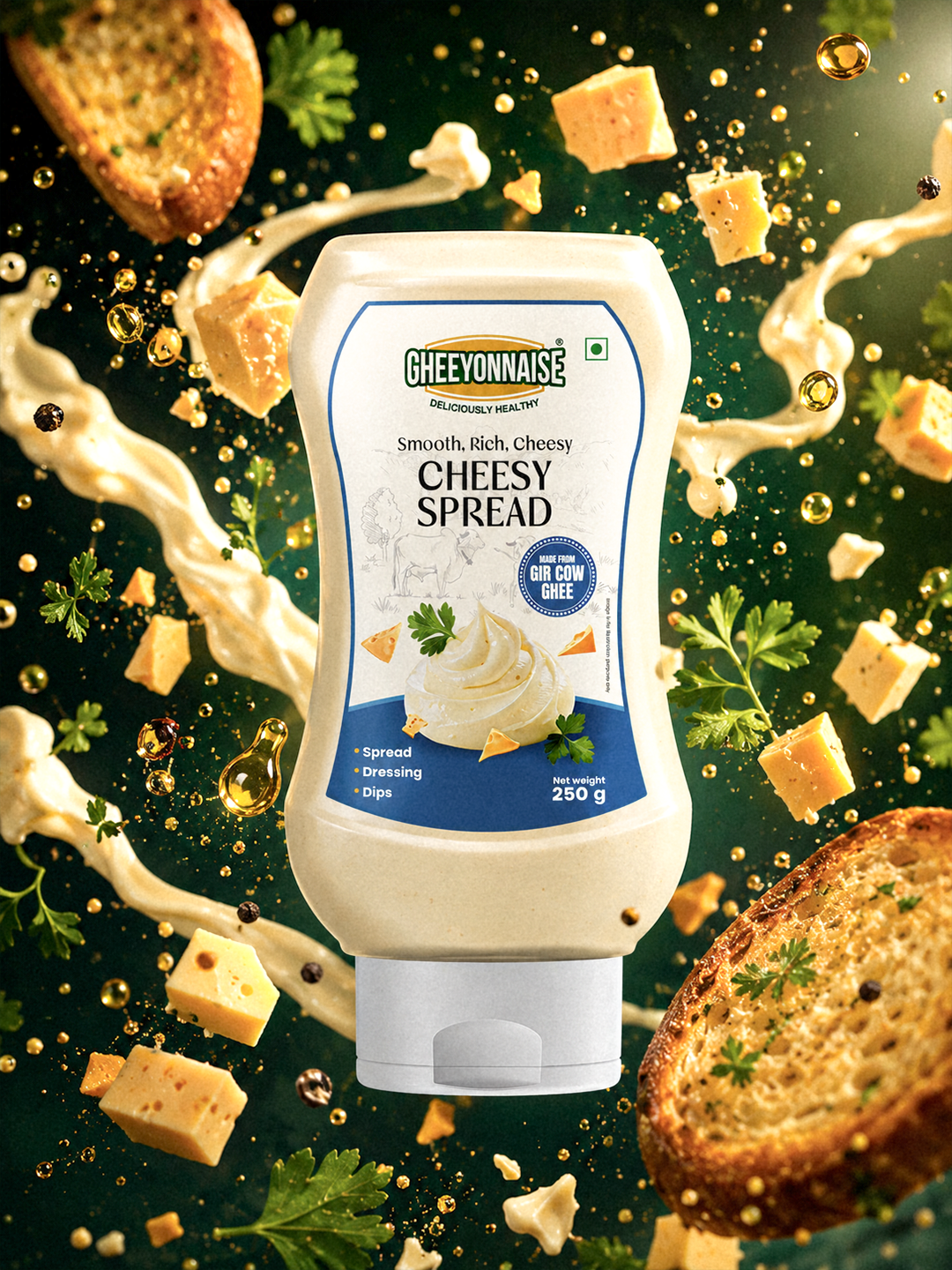
In India, paediatricians commonly recommend introducing ghee after 6 months as part of complementary feeding. Ghee provides concentrated energy (120 cal/tbsp) and fat-soluble vitamins that growing brains need. The FSSAI recognises ghee as a traditional infant food. Start with small amounts (half a teaspoon in dal or khichdi) and consult your child's paediatrician. For older kids, our Cheesy Spread made with A2 Gir Cow Ghee is a preservative-free alternative to processed cheese spreads in school lunchboxes.
Does ghee help with weight loss?
Ghee doesn't cause weight loss directly, but its CLA content (0.80% in cow ghee) has shown modest fat-reduction effects in early research. More importantly, ghee's short- and medium-chain fatty acids are used for energy rather than stored as fat. The key is portion control: at 120 calories per tablespoon, ghee adds up quickly if overused.
Is A2 cow ghee healthier than regular ghee?
A2 ghee comes from indigenous cow breeds (like Gir) that produce A2 beta-casein protein. While A2 vs A1 ghee research is still emerging, A2 ghee from grass-fed cows consistently shows 3 to 5 times more fat-soluble vitamins than grain-fed alternatives. India's A2 ghee market is growing at 22.3% CAGR, reflecting strong consumer preference (IMARC Group, 2025). Learn more about our A2 Gir Cow Ghee sourcing.
The Bottom Line
So, is ghee healthy? The peer-reviewed evidence says: yes, with caveats.
- Gut health: Ghee's 3 to 4% butyric acid content is backed by real science. It fuels your colon cells.
- Cooking safety: At 485°F, ghee is the most heat-stable common cooking fat, a genuine advantage for daily Indian cooking.
- Lactose: At <2.9 mg per 100g, ghee is effectively lactose-free.
- Vitamins: Meaningful amounts of A, E, and K2, especially from grass-fed and A2 sources.
- Heart health: Mixed evidence. Moderation (1 to 2 tbsp/day) appears safe for healthy adults.
The science backs what Indian kitchens have known for centuries. Ghee, used wisely, is a nourishing fat. The key word is "wisely." A spoonful in your dal or a drizzle on your paratha? That's tradition meeting evidence. Half a cup on everything? That's excess meeting consequence. Kehul Shah, founder of Gheeyonnaise and a third-generation ghee manufacturer, puts it simply: "Ghee is not a magic pill. It's a superior cooking fat that earns its place in a balanced Indian kitchen."
Want to bring ghee's benefits into your daily meals? Explore our range of A2 Gir Cow Ghee-based spreads, five flavours, zero palm oil, zero preservatives.
Sources
- Kataria, D. & Singh, G. "Health benefits of ghee: Review of Ayurveda and modern science perspectives." Journal of Ayurveda and Integrative Medicine, Vol. 15(1):100819, January 2024. Retrieved 2026-05-11. https://pmc.ncbi.nlm.nih.gov/articles/PMC10789628/
- Mohammadi-Nasrabadi, F. et al. "A Comparative Analysis of Butter, Ghee, and Margarine: SWOT Analysis." Food Science & Nutrition, Wiley, 2024. Retrieved 2026-05-11. https://onlinelibrary.wiley.com/doi/full/10.1002/fsn3.4557
- Parr, C.L. et al. "The lactose and galactose content of milk fats and suitability for galactosaemia." BMC Nutrition, PMC5471386, 2017. Retrieved 2026-05-11. https://pmc.ncbi.nlm.nih.gov/articles/PMC5471386/
- IMARC Group. "Ghee Market Growth Drivers, Size, Analysis | Forecast 2034." 2025. Retrieved 2026-05-11. https://www.imarcgroup.com/ghee-market
- IMARC Group. "India A2 Ghee Market Size, Share, Growth & Forecast 2033." 2025. Retrieved 2026-05-11. https://www.imarcgroup.com/india-a2-ghee-market
- Straits Research. "India Functional Food Market Size Report By 2031." 2024. Retrieved 2026-05-11. https://straitsresearch.com/vertex/insights/functional-food-market/india
- PwC India. "Voice of the Consumer 2025: India Perspective." September 2025. Retrieved 2026-05-11. https://www.pwc.in/press-releases/2025/84-of-indian-consumers-seek-safer-healthier-food-choices-pwc-report.html
- vom Fass. "Smoke Point of Oils Chart: 30+ Oils Ranked by Temperature." 2026. Retrieved 2026-05-11. https://vomfassusa.com/blogs/gourmet-foods/smoke-point-of-oils
- Kataria, D. & Singh, G. "From tradition to science: Possible mechanisms of ghee in supporting bone and joint health." Journal of Ayurveda and Integrative Medicine, ScienceDirect, 2024. Retrieved 2026-05-11. https://www.sciencedirect.com/science/article/abs/pii/S1098882324000960

0 comments