

Ghee and butter look like the same thing wearing different clothes. Both start as cream, both are golden, both are cow-milk fat. But ghee is butter that's been simmered until its water boils off and its milk solids are strained away. That one step changes how each behaves in the pan, on the shelf, and in a lactose-sensitive stomach.
So which one actually belongs in your kitchen? The honest answer is that they're more alike than the internet suggests. Ghee isn't a health miracle, and butter isn't the villain. The real differences are about processing and practicality, not disease claims.
As someone from a family that's spent three generations making ghee, I've watched this comparison get oversold in both directions. Here's what the composition data actually says, where each one wins, and how to choose based on how you cook.
Key Takeaways
- Ghee is nearly pure fat (under 0.5% water); butter is about 16% water and retains milk solids (Food Science & Nutrition, 2024).
- Clarification removes most lactose and casein, so many lactose-sensitive people tolerate ghee better than butter. It is not guaranteed allergen-free.
- Both are cow-milk fat: butter is 66.69g saturated fat per 100g, ghee 64.26g. The nutrient gap is modest, not dramatic.
- Ghee tolerates higher cooking heat and lasts longer unrefrigerated. Butter wins on cost, baking, and fewer calories per gram.
Ghee vs. Butter at a Glance
If you read only one section, read this. The differences come down to what clarification takes out: water and milk solids. Everything else follows from that. India's ghee market alone reached INR 3,774.5 billion in 2025 and is projected to hit INR 7,532.7 billion by 2034 at a 7.70% CAGR (IMARC Group, Ghee Market in India, 2025), so this is a choice millions of households make daily.
| Category | Ghee | Butter |
|---|---|---|
| Water content | Under 0.5% | ~16% |
| Total fat (per 100g) | ~99.5g | ~81g |
| Saturated fat (per 100g) | 64.26g | 66.69g |
| Calories (per 100g) | ~900 | ~717 |
| Milk solids | Removed | Present |
| Lactose / casein | Largely removed | Retained |
| Heat tolerance | High smoke point | Scorches sooner |
| Shelf life at room temp | Months | Needs refrigeration |
| Best for | High-heat cooking, tempering, shelf life | Baking, spreading, lower cost |
| Our verdict | Wins for cooking & sensitivity | Wins for baking & budget |
Notice the saturated fat row. Butter actually edges ghee on saturated fat per 100 grams. Anyone who tells you ghee is a low-saturated-fat alternative to butter is selling something.
What's the Actual Composition Difference?
The headline difference is water. Butter holds about 16 grams of water per 100 grams; ghee holds under half a gram, because clarification boils it off (Food Science & Nutrition, SWOT analysis of butter, ghee and margarine, 2024). What's left in ghee is nearly pure butterfat.

That has a counterintuitive effect. Because ghee has no water diluting it, it's more concentrated. Gram for gram, ghee carries more fat and more calories than butter, roughly 900 kcal per 100g versus 717 for butter. So "switching to ghee" doesn't make a spoonful lighter. If anything, it's slightly denser.
On saturated fat, the two are close and butter is marginally higher: 66.69 grams per 100g for butter versus 64.26 grams for ghee, in a 2024 peer-reviewed comparison. Both are cow-milk fat, so their fatty-acid profiles are cousins, not opposites.
Per 100 grams, ghee contains under 0.5 grams of water versus roughly 16 grams in butter, because clarification boils off moisture and strains out milk solids (Food Science & Nutrition, 2024). This makes ghee nearly pure butterfat, and slightly more calorie-dense per gram than butter.
Verdict: Butter wins on fewer calories per gram; ghee wins on purity and fat concentration. On saturated fat, they're effectively tied.
Which One Handles Heat Better?
Ghee wins decisively on heat. Butter's milk solids and water are exactly what scorch and splatter over a flame, and clarification removes both. That's why ghee has a noticeably higher smoke point than butter and holds up to Indian high-heat cooking, tempering, and deep-frying without burning.
Put butter in a hot pan and the milk proteins brown, then blacken and turn bitter fast. That browning is lovely for a beurre noisette, but useless for a tadka or a stir-fry. Ghee has nothing left to brown, so it stays stable at temperatures that would ruin butter.
Butter isn't out of the running, though. For gentle sautéing, finishing a sauce, or anything where you want that nutty browned-milk flavour, butter's solids are a feature, not a bug. It comes down to the heat you're cooking at.
Our take: This is why Indian kitchens reached for ghee long before anyone measured a smoke point. Tempering spices in hot fat is central to our cooking, and butter simply can't survive that heat. Tradition solved the chemistry by instinct.
Ghee tolerates far higher cooking heat than butter because clarification removes the milk solids and water that scorch over a flame. That is why ghee suits Indian high-heat cooking, tempering, and deep-frying, while butter's milk proteins brown and turn bitter quickly in a hot pan (Food Science & Nutrition, 2024).
Verdict: Ghee wins for high heat and tempering. Butter wins when you actually want the browned-milk flavour.
Which Is Gentler for Lactose or Casein Sensitivity?
Ghee is usually the gentler choice. The lactose and casein in dairy sit in the milk solids, and clarification strains most of those solids out. That's why many people who react to butter tolerate ghee comfortably. Ghee's moisture drops below 0.1% during this process, taking most of the solids with it (Food Science & Nutrition, 2024).
Butter keeps its milk solids, so it keeps more of its lactose and casein. For someone with mild lactose intolerance, that can be the difference between comfort and a stomach ache.
Here's the honest caveat, and it matters. Ghee is not guaranteed dairy-free. Trace milk proteins can survive clarification, so anyone with a diagnosed milk allergy, not just lactose intolerance, should treat ghee with caution and check with a doctor first. "Lower in lactose" is not the same as "safe for a milk allergy."
Because ghee is clarified, the milk solids that carry lactose and casein are largely removed, which is why many lactose-intolerant people tolerate ghee better than butter. Ghee is not certified allergen-free, however: trace milk proteins can remain, so those with a diagnosed milk allergy should consult their healthcare provider.
Curious how far that goes? We cover it in depth in our guide to whether ghee is healthy and what the science says.
Verdict: Ghee wins for lactose sensitivity. Neither is safe for a genuine milk allergy without medical advice.
Do the Nutrients Really Differ?
Less than the marketing implies. Both ghee and butter are cow-milk fat, so both carry butyric acid, CLA, and fat-soluble vitamins. Butter and ghee contain butyric acid at around 4% of their fatty acids, the highest of any natural fat, and ghee is also a carrier of vitamins A, D, E, and K2 (Food Science & Nutrition, 2024).
Ghee holds slightly more vitamin A per 100 grams, roughly 840 micrograms versus 684 in butter, mostly because it's more concentrated once the water is gone (USDA FoodData Central). Butyric acid, CLA, and vitamin K2 show up in both. These are meaningful nutrients, but the gap between the two is modest.
Now the balance, stated plainly. Both fats are roughly 64 to 67% saturated fat, and the science on saturated fat and heart health is genuinely mixed. A widely cited 2010 pooled analysis found no significant association between saturated fat intake and cardiovascular disease (American Journal of Clinical Nutrition, 2010), while major bodies like the WHO and ICMR-NIN still advise limiting it. Neither ghee nor butter is a health food you should eat freely. Moderation applies to both, and anyone managing cholesterol or heart conditions should consult their healthcare provider.
One warning worth its own line: pure ghee is nothing like "vegetable ghee" or vanaspati, the hydrogenated substitute that can contain up to 40% industrial trans fats. Trans fats carry clear cardiovascular risk, and just a 2% increase in trans-fat energy has been linked to about 23% higher heart-disease risk (Food Science & Nutrition, 2024). Read the label. Real ghee lists one ingredient.
Both ghee and butter are cow-milk fat, so both carry butyric acid at about 4% of their fatty acids, plus CLA and fat-soluble vitamins. Ghee holds slightly more vitamin A per 100 grams, roughly 840 micrograms versus 684 in butter, mostly because it is more concentrated once the water is removed (USDA FoodData Central; Food Science & Nutrition, 2024).
Verdict: Roughly a tie on nutrition. Ghee's edge is concentration, not a different nutrient class.
Which Wins on Shelf Life and Cost?
Ghee wins on the shelf; butter wins on the receipt. With almost no water and no milk solids to spoil, ghee keeps for months at room temperature, while butter needs refrigeration and turns rancid faster. That storage edge is a genuine practical advantage, especially in Indian kitchens without constant cold storage.
Butter has its own real wins. It's usually cheaper, more widely available, and its water content matters for baking, laminated pastry and creaming depend on it. Swap ghee into a croissant recipe and the science works against you. For spreading on warm toast, butter's softness and water give a texture ghee can't match.
The premium end of this category is growing fast. India's A2 ghee market reached INR 1.28 billion in 2025 and is projected to reach INR 9.51 billion by 2034, a striking 21.41% CAGR (IMARC Group, India A2 Ghee Market, 2025), as more households trade up from mass-market fats.
With almost no water and no milk solids to spoil, ghee keeps for months at room temperature, while butter needs refrigeration. India's A2 ghee market reflects this premium shift, growing from INR 1.28 billion in 2025 to a projected INR 9.51 billion by 2034, a 21.41% CAGR (IMARC Group, 2025).
Verdict: Ghee wins on shelf life and heat-cooking value. Butter wins on cost, availability, and baking.
The A2 Gir Cow Question, Honestly
The A2 story is real but often overstated. A2 refers to a type of beta-casein protein in milk from certain cow breeds, like the Indian Gir. Four systematic reviews conclude that A2 milk may ease gastrointestinal discomfort compared with A1 milk, but that broader health benefits are inconclusive, and that there's no evidence A1 casein actually harms human health (Systematic Review of the Gastrointestinal Effects of A1 vs A2 Beta-Casein, 2017).
Here's the part few brands admit: casein lives in the milk solids, and ghee has most of its milk solids removed. So the A2-versus-A1 distinction matters far more for milk than for finished ghee. When we talk about A2 Gir cow ghee, the honest value is in the heritage breed, the traditional sourcing, and the flavour, more than a proven clinical edge in the jar.
That doesn't make it marketing fluff. In Ayurveda, ghee (ghrita) has been valued for millennia. Classical texts like the Charaka Samhita describe it as "yogavahi," a carrier that helps deliver the properties of herbs into the body (Journal of Ayurveda and Integrative Medicine, 2023). That's tradition and cultural context, not a medical claim, and it's exactly why we build on A2 Gir cow ghee in our Classic Spread.
Systematic reviews find that A2 milk may reduce gastrointestinal discomfort versus A1 milk, but that other health benefits remain inconclusive and there is no evidence A1 casein harms health (A1 vs A2 Beta-Casein Systematic Review, 2017). Because casein sits in milk solids that clarification removes, the A2 distinction matters more for milk than for finished ghee.
Verdict: A2 Gir cow ghee earns its premium on heritage, sourcing, and taste, not on inflated health claims.
Who Should Choose Which?
The right fat depends on what you're doing with it. Here's the simple rule: cook Indian and cook hot, choose ghee; bake and spread on a budget, choose butter.
High-heat and Indian cooks: Choose ghee. Tempering, frying, roasting, and tadka all need a fat that survives heat, and ghee's clarified structure is built for it.
Lactose-sensitive eaters: Lean ghee. With most milk solids removed, it's usually gentler than butter, though not safe for a genuine milk allergy.
Bakers and budget shoppers: Butter is the honest pick. Its water content matters for pastry and creaming, it spreads better cold, and it costs less. For croissants and cakes, butter wins outright.
Most Indian kitchens don't have to choose. Keep ghee for the stovetop and butter for the oven and the toast, and let each do what it's good at.
Frequently Asked Questions
Is ghee actually healthier than butter?
Not dramatically. Both are cow-milk fat with similar saturated fat, butter at 66.69g and ghee at 64.26g per 100g (Food Science & Nutrition, 2024). Ghee's real advantages are practical: higher heat tolerance, longer shelf life, and less lactose. On core nutrition, they're close cousins, and both should be used in moderation.
Can I replace butter with ghee 1:1 in recipes?
For cooking and sautéing, yes, though use slightly less ghee since it's pure fat with no water. For baking, be careful: butter's roughly 16% water content affects texture in pastry, cakes, and creaming, so a straight swap can change the result. Ghee works best where you're cooking with heat, not building structure.
Is ghee lactose-free?
Ghee is very low in lactose because clarification removes most of the milk solids where lactose and casein sit. Many lactose-intolerant people tolerate it well. It is not certified lactose-free or allergen-free, though, so anyone with a diagnosed milk allergy should consult their healthcare provider before using it.
Is ghee or butter better for weight loss?
Neither is a weight-loss food. Ghee is actually more calorie-dense per gram, about 900 kcal per 100g versus 717 for butter, because it has no water (USDA FoodData Central). Portion size matters far more than which one you choose. Use either sparingly within a balanced diet.
The Bottom Line
Ghee and butter are the same fat at different stages of refinement, and the winner depends entirely on the job.
| Category | Winner |
|---|---|
| Composition / calories per gram | Butter |
| Heat tolerance | Ghee |
| Lactose / casein sensitivity | Ghee |
| Nutrient profile | Tie |
| Shelf life | Ghee |
| Cost & baking | Butter |
| Overall | Depends on the job: ghee for cooking, butter for baking |
Don't switch to ghee expecting a health transformation, and don't fear butter as if it were poison. Choose ghee when you're cooking hot, need a longer shelf life, or react to lactose. Choose butter when you're baking, spreading, or watching the budget. Both have earned their place in the kitchen.
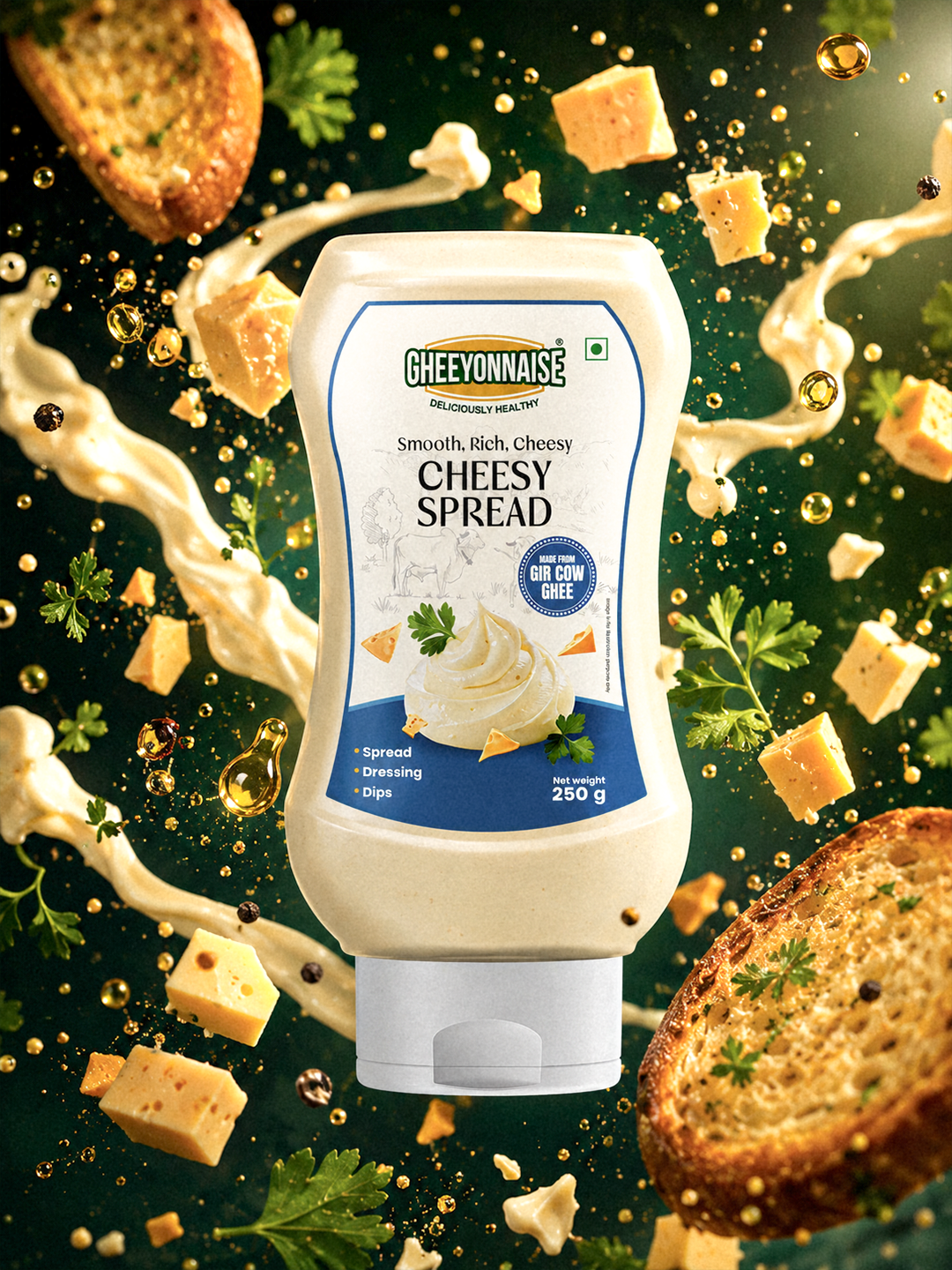
If you'd like a ghee that starts with A2 Gir cow ghee as its base, try our Classic Spread, or explore all five flavours and taste what tradition made first.
"People ask me if ghee is 'better' than butter. My honest answer is that ghee is butter with the water and milk solids taken out. That makes it better for some things and not others. Respect the difference, and use each one well."
- Kehul Shah, Founder, Gheeyonnaise
Health-adjacent note: this article is educational and not medical advice. Both ghee and butter are high in saturated fat. Consult your healthcare provider for guidance specific to your health.
Want to go deeper on ghee's science? Read Is Ghee Healthy? What Science Says in 2026, or see how ghee compares against the oils in your condiments in Ghee vs. Seed Oils in Mayo.

1 comment
qb7qee