

Most mayonnaise in India is built on refined seed oils. Soybean, sunflower, palm, or a blend hiding behind "edible vegetable oil" on the label. Ghee-based mayo flips that formula, using clarified butter as the base instead. So which one actually belongs in your fridge?
The context matters. In 2025, Business Standard reported that India's per capita edible oil consumption reached 23.5 kg per year, nearly double the 12 kg limit recommended by ICMR (Business Standard, India's edible oil consumption, April 2025). We're eating more refined oil than ever, and most of it arrives through processed foods we don't think twice about.
This is a fair comparison, not a takedown. Seed oils are cheaper, more neutral in flavour, and genuinely useful for some things. Ghee costs more and carries its own trade-offs. Here's how the two bases stack up on sourcing, stability, nutrition, and price, so you can decide what your condiment should be made of.
Key Takeaways
- Ghee wins on oxidative stability and fat-soluble vitamins; seed oils win on cost and neutral flavour.
- Modern diets run an omega-6 to omega-3 ratio of roughly 15:1 to 20:1, versus about 1:1 for most of human history (Simopoulos, PMC, 2016). Seed oils are a major source of that omega-6 load.
- Ghee carries butyric acid, CLA, and vitamins A, D, E, and K2. Refined seed oils are stripped of most of these during processing.
- Both are high in fat. Ghee is high in saturated fat and its cardiovascular evidence is mixed, so moderation matters with either base.
Ghee vs. Seed Oils in Mayo at a Glance
If you only read one section, read this one. The two bases differ most on how they're made, what nutrients survive, and what you pay. In 2025, IMARC Group valued India's mayonnaise market at USD 455.66 million, projecting it to reach USD 850.06 million by 2034 at a 6.20% CAGR (IMARC Group, India Mayonnaise Market, 2025). Almost all of that volume still runs on seed oil.
| Category | Ghee Base | Seed Oil Base |
|---|---|---|
| Best for | Ingredient quality, nutrient density | Lowest cost, neutral taste |
| How it's made | Slow clarification of butter | Solvent extraction + high-heat refining |
| Omega-6 (linoleic acid) | Low (~2-3%) | High (soybean ~51%, sunflower ~60%) |
| Heat stability | High (mostly saturated) | Lower (PUFA-rich, oxidation-prone) |
| Fat-soluble vitamins | A, D, E, K2 present | Largely stripped in refining |
| Palm oil involved | None | Often (India's oil mix is 37%+ palm) |
| Relative price | Premium (~2-2.5x) | Cheapest option |
| Our verdict | Wins on quality & nutrition | Wins on price |
The rest of this post unpacks each row. Full disclosure on credibility: I'm from a family that's spent three generations working with ghee, and we chose it as our base after weighing exactly these trade-offs.
What's Actually in the Base?
Ghee wins on sourcing transparency because it's a single, recognisable ingredient, while most seed oil in condiments is refined, bleached, and deodorised before it reaches the jar. In 2025, palm oil alone made up over 37% of India's edible oil consumption, with soybean oil adding roughly another 20% (Business Standard, April 2025).
Seed oils used in mayo are industrial products. Soybean, sunflower, and palm are typically extracted with solvents, then refined at high temperature to strip colour and odour. That gives manufacturers a cheap, neutral, shelf-stable fat. It also strips most of the original nutrients.
Ghee takes the opposite route. It's made by gently simmering butter until the water evaporates and milk solids separate out. No solvents, no high-temperature refining. What's left is nearly pure butterfat that has carried flavour and nutrition through Indian kitchens for generations.

The nuance? Not all seed oil is villainous. Cold-pressed mustard or groundnut oil is a different story from refined palmolein. But the oil inside a typical mayo jar is almost always the heavily refined kind, chosen for price and neutrality rather than nutrition.
Verdict: Ghee wins for a clean, single-ingredient base. Seed oils win only if the cheapest possible fat is the goal.
In 2025, refined palm and soybean oils accounted for well over half of India's edible oil consumption, and both are common bases for packaged mayonnaise (Business Standard, 2025). Ghee, by contrast, is a single clarified-butter ingredient made without solvent extraction or high-temperature refining, so its natural nutrients largely survive.
Which Base Handles Heat and Oxidation Better?
Ghee wins on stability because it's mostly saturated fat, which resists oxidation far better than the polyunsaturated fats that dominate seed oils. Ghee is roughly 60-65% saturated fat, giving it few of the reactive double bonds that make oils go rancid (ScienceDirect, Nutritional composition of ghee, 2024).
Here's the chemistry in plain terms. Polyunsaturated fats (PUFAs) have multiple double bonds that oxygen and heat love to attack. When PUFA-heavy oils are heated or stored for long periods, they oxidise and form compounds you'd rather not eat. Saturated fats like ghee have far fewer of those weak points.
Seed oils sit on the vulnerable end of that spectrum. Soybean oil is around 51% linoleic acid, and sunflower oil can run near 60% (USDA FoodData Central). Ghee comes in around 2 to 3%. That single difference is why ghee has traditionally been prized for cooking, storage, and shelf life without refrigeration.
The nuance runs the other way here too. In a cold, emulsified condiment like mayo, oxidation is slower than in a hot frying pan. So the stability gap matters less in a jar of mayo than it would in a deep fryer. Still, a more stable base means a cleaner fat going in and a longer, more graceful shelf life.
Ghee is roughly 60 to 65% saturated fat, giving it far fewer reactive double bonds than the polyunsaturated seed oils used in most mayo. Soybean oil is about 51% linoleic acid and sunflower near 60%, versus ghee's 2 to 3%, which is why ghee resists oxidation and rancidity far better (ScienceDirect, 2024; USDA FoodData Central).
Verdict: Ghee wins clearly on oxidative stability. Seed oils close some of the gap in a cold, sealed condiment, but never lead.
What Is the Omega-6 Problem, Really?
Seed oils tilt your diet toward omega-6, and most of us already get far too much. Modern diets run an omega-6 to omega-3 ratio of roughly 15:1 to 20:1, compared with about 1:1 for most of human evolution (Simopoulos, PMC, 2016). Refined seed oils are the single biggest driver of that shift.
Omega-6 fats aren't harmful in themselves. They're essential, and your body needs some. The concern researchers raise is about balance. When omega-6 intake vastly outweighs omega-3, some studies associate the imbalance with higher inflammatory activity, though the evidence is still debated and far from settled.
Ghee barely moves this ratio because it contains very little polyunsaturated fat of either kind. Swapping a seed-oil condiment for a ghee-based one won't fix your omega balance on its own. But it removes one everyday source of excess omega-6 from your plate.
Our take: A condiment is a small part of anyone's diet. But it's a daily part. The value of a ghee base isn't that it corrects your omega ratio single-handedly. It's that it stops adding to a load that's already too high, one sandwich at a time.
Modern diets run an omega-6 to omega-3 ratio of roughly 15:1 to 20:1, compared with about 1:1 for most of human evolution, and refined seed oils are the largest driver of that shift (Simopoulos, PMC, 2016). Ghee contains very little polyunsaturated fat, so it barely moves the ratio.
Verdict: Seed oils lose this round on balance. Ghee is close to neutral on the omega-6 question.
What Nutrients Come With Each Base?
Ghee brings nutrients along with its fat; refined seed oils bring mostly calories. A 2024 analysis confirmed that ghee provides around 606 micrograms of vitamin A and 1,650 micrograms of vitamin E per 100 grams, plus 4 to 5 grams of butyric acid and 0.4 to 0.7 grams of conjugated linoleic acid (ScienceDirect, Nutritional composition of ghee, 2024). Refining strips most seed oils of comparable micronutrients.
Butyric acid is the standout. It's a short-chain fatty acid that may support gut lining health, and ghee is one of the richest dietary sources. Ghee also carries vitamin K2, which is involved in how the body directs calcium. Refined seed oils deliver little of either.
Now the honest counterpoint. Ghee is high in saturated fat, roughly 60% by weight, and the evidence on ghee and heart health is genuinely mixed. Some studies show no significant change in blood lipids, others show increases in cholesterol markers. Seed oils, for all their omega-6 load, are lower in saturated fat, and India's ICMR-NIN 2024 dietary guidelines actually rated palm oil favourably for its monounsaturated fat content (ICMR-NIN, Dietary Guidelines for Indians, 2024). Neither base is a health halo. If you have a cardiovascular condition or specific dietary concerns, consult your healthcare provider before making fats a centrepiece of your diet.
According to a 2024 nutritional analysis, ghee supplies roughly 606 micrograms of vitamin A, 4 to 5 grams of butyric acid, and conjugated linoleic acid per 100 grams, none of which survive in meaningful amounts through the refining of seed oils (ScienceDirect, 2024). Both fats remain calorie-dense and should be used in moderation.
Verdict: Ghee wins on nutrient density. Seed oils win narrowly on lower saturated fat, an advantage tempered by mixed evidence for both.
Does a Ghee Base Justify the Price?
Ghee costs more, and that's the seed oil base's strongest advantage. Premium ghee-based spreads sell at roughly 2 to 2.5 times the price of mainstream seed-oil mayo, a gap driven almost entirely by the base ingredient. India's ghee market itself was valued at INR 3,774.5 billion in 2025, projected to reach INR 7,532.7 billion by 2034 at a 7.70% CAGR (IMARC Group, Ghee Market in India, 2025).
What we've noticed: When we developed Gheeyonnaise, sourcing A2 Gir Cow Ghee as the base cost us roughly 2 to 2.5 times more than refined seed oil would have. That single decision is why most brands never leave palm and soya behind. The base ingredient is where the money is spent or saved.
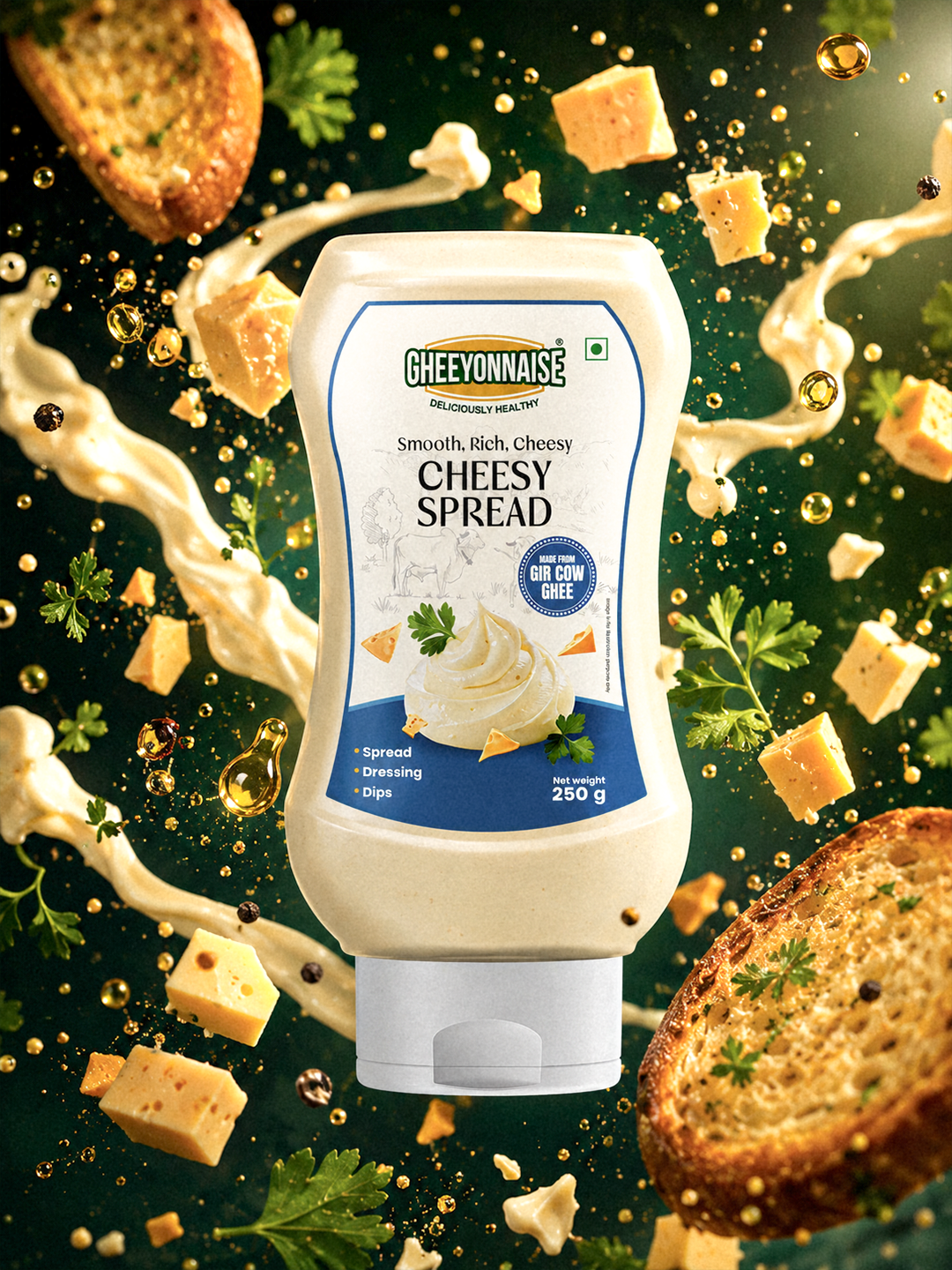
On taste and texture, the two go different directions. Seed oil gives a neutral, flavour-agnostic mayo that carries added seasonings cleanly. Ghee brings a warm, faintly nutty richness of its own, which is why our Cheesy Spread tastes fuller than a standard jar. Whether that's a plus depends on your palate.
So is the premium worth it? If you use mayo occasionally and cost drives the decision, seed oil does the job. If it's a daily staple and you'd rather your everyday fat came with nutrients instead of solvents, the ghee premium starts to look like value rather than markup.
Premium ghee-based spreads sell at roughly 2 to 2.5 times the price of mainstream seed-oil mayo, a gap driven almost entirely by the base ingredient. India's ghee market was valued at INR 3,774.5 billion in 2025, projected to reach INR 7,532.7 billion by 2034 at a 7.70% CAGR (IMARC Group, 2025).
Verdict: Seed oils win decisively on price. Ghee wins on value per gram for anyone who eats it regularly.
Who Should Choose Which?
The right base depends on what you're optimising for. Here's the simple rule: choose ghee if ingredient quality drives your decisions, choose seed oil if cost does. That quality-first choice is spreading fast: in 2025, clean-label demand in India moved beyond metros into tier-2 and tier-3 cities as shoppers scrutinised ingredient lists more closely (Expert Market Research, India Clean Label Flavours, 2025).
Quality-first parents: Choose a ghee base. If mayo goes into your kids' lunchboxes and sandwiches several times a week, a clean, nutrient-carrying fat is worth the premium over refined palm or soya.
Macro-tracking fitness enthusiasts: Lean ghee. The fat-soluble vitamins, butyric acid, and CLA give you more than empty fat calories, and the low omega-6 load fits a diet already watching its fat balance.
Budget-driven households: Seed oil mayo is the honest pick. If price is the deciding factor and mayo is an occasional treat, the premium for ghee may not be justified for you, and that's a fair call.
If you fall between these, split the difference. Use ghee-based spreads for the meals you eat daily and keep a cheaper jar for high-volume, occasional uses like party dips.
Frequently Asked Questions
Is ghee-based mayo actually healthier than seed-oil mayo?
Ghee-based mayo replaces refined seed oil with clarified butter, which carries butyric acid (4 to 5 grams per 100 grams), CLA, and vitamins A, D, E, and K2 (ScienceDirect, 2024). It also avoids the heavy omega-6 load of seed oils. But ghee is high in saturated fat, so "healthier" depends on your overall diet. Both should be used in moderation.
Can you cook with ghee-based mayo like you would with oil?
Mayo of any kind is an emulsion, not a cooking oil, so it's meant for spreading and dressing rather than frying. That said, ghee's high smoke point and saturated structure make it more heat-stable than the polyunsaturated seed oils used in most mayo, which oxidise faster when heated (ScienceDirect, 2024).
Why does ghee-based mayo cost more?
The base ingredient. Ghee, especially A2 Gir Cow Ghee, costs roughly 2 to 2.5 times more than refined seed oil, and that gap flows straight into the shelf price. India's ghee market reflects this premium positioning, valued at INR 3,774.5 billion in 2025 (IMARC Group, 2025).
Is ghee-based mayo safe if I'm lactose-sensitive?
Ghee is clarified butter, which means the milk solids and most of the lactose are removed during its slow simmering process. Many lactose-sensitive people tolerate ghee well, though sensitivity varies. If you have a diagnosed dairy allergy rather than lactose intolerance, consult your healthcare provider before trying it.
The Bottom Line
Line up the categories and the pattern is clear. One base is built for the lowest possible cost; the other is built for what actually goes into your body every day.
| Category | Winner |
|---|---|
| Sourcing & processing | Ghee |
| Heat & oxidative stability | Ghee |
| Omega-6 balance | Ghee |
| Nutrient density | Ghee |
| Price | Seed oils |
| Overall | Ghee (for anyone who eats mayo regularly) |
Seed oils earn their place on price, and for occasional use that can be enough. But on sourcing, stability, omega balance, and nutrition, a ghee base wins on the merits. For a condiment you reach for often, those merits compound.
Curious what a ghee base actually tastes like? Try Gheeyonnaise Classic Spread, made with 100% A2 Gir Cow Ghee, or explore all five flavours and taste the difference the base makes.
"Every mayo comes down to one question: what's the fat? We answered it with A2 Gir Cow Ghee instead of refined oil. It costs more to make. It's also the whole point."
- Kehul Shah, Founder, Gheeyonnaise
Health-adjacent note: this article is educational and not medical advice. Both ghee and seed oils are calorie-dense fats. Consult your healthcare provider for guidance specific to your health.
Want the deeper science on ghee itself? Read Is Ghee Healthy? What Science Says in 2026, or see Why Palm Oil in Mayo Should Concern You for a closer look at the seed oil most mayo is built on.

0 comments