

Most mayonnaise jars in India are built on palm oil. It's cheap, shelf-stable, and flavourless, which makes it ideal for manufacturers. But in 2025, Business Standard reported that India's per capita edible oil consumption has hit 23.5 kg per year, nearly double the 12 kg limit recommended by ICMR (Business Standard, India's edible oil consumption, April 2025). Palm oil alone accounts for over 37% of that intake.
That number landed differently for me. As someone from a family that's spent three generations working with ghee, I know what honest fat looks like. It doesn't need to hide behind the phrase "edible vegetable oil" on an ingredient label.
Here's what the science says about the oil sitting inside your mayo jar, why regulators across the world are tightening the screws on it, and what cleaner alternatives actually exist.
Key Takeaways
- Palm oil carries the highest levels of process contaminants (3-MCPD and glycidyl esters) among all vegetable oils, per EFSA's scientific opinion.
- In 2025, 84% of Indian consumers said food safety drives their purchase decisions (PwC India, Voice of the Consumer).
- Ghee provides butyric acid, CLA, and vitamins A, D, E, K2. Refined palm oil provides none of these.
- FSSAI is pushing for bolder labelling of saturated fat and sugar on packaged foods, making palm oil harder to hide.
What Is Palm Oil Doing in Your Mayonnaise?
In 2024, IMARC Group valued India's mayonnaise market at USD 428 million, projecting it to reach USD 800.4 million by 2033 at a 6.46% CAGR (IMARC Group, India Mayonnaise Market Report, 2024). That's a massive volume of condiment moving through Indian kitchens. And the base ingredient in most of it? Palm oil or soybean oil.
Why palm oil? Three reasons: cost, stability, and neutrality. Palm oil is significantly cheaper than olive oil, ghee, or even mustard oil. It doesn't spoil quickly. And it has almost no flavour, which lets manufacturers control the taste profile with additives instead.
What we've noticed: When we developed Gheeyonnaise, sourcing A2 Gir Cow Ghee as the base cost us roughly 2 to 2.5 times more than palm oil would have. That price gap is exactly why most brands don't bother with alternatives.
India imports roughly 57% of its edible oil needs. In the marketing year 2024/25, palm oil imports alone hit 9.3 million metric tonnes, primarily from Indonesia and Malaysia (USDA Foreign Agricultural Service, India Oilseeds Update, 2024). That imported oil flows into biscuits, chips, noodles, and yes, your favourite mayonnaise.
What Does Science Say About Palm Oil Contaminants?
In 2016, the European Food Safety Authority published a landmark scientific opinion that still shapes global food regulation. EFSA tested all major vegetable oils for process contaminants. Refined palm oil came out worst (EFSA, Risks related to the presence of 3-MCPD and glycidyl esters in food, 2016).
The numbers are stark. Mean glycidol levels in palm fat hit 3,955 micrograms per kilogram. Mean 3-MCPD levels reached 2,912 micrograms per kilogram. No other vegetable oil came close.
These aren't naturally present in palm fruit. They form when vegetable oils are refined at temperatures around 200 degrees Celsius. This oil is particularly vulnerable because it contains 4 to 12% diacylglycerols (DAG), which generate more glycidyl esters during high-heat processing.
Here's the critical part. EFSA concluded that glycidol is genotoxic and carcinogenic. No safe level was established for glycidyl esters. For 3-MCPD, EFSA later revised the tolerable daily intake to 2 micrograms per kilogram of body weight per day (EFSA, Revised safe intake for 3-MCPD, January 2018).
In February 2024, the WHO published a rapid overview of systematic reviews examining palm oil intake versus other vegetable oils, specifically looking at mortality and cardiovascular health outcomes (WHO, Palm oil intake and cardiovascular health, February 2024). The review cited Cochrane-level evidence that reducing saturated fat intake for at least two years causes "important reductions" in combined cardiovascular events.
Does this mean palm oil will harm you today? Not necessarily. But when it's the base of a condiment you use daily, the cumulative exposure adds up.
According to EFSA's 2016 scientific opinion, refined palm oil contains mean glycidol levels of 3,955 micrograms per kilogram, the highest of any vegetable oil tested. The authority classified glycidol as genotoxic and carcinogenic, declining to set a safe exposure threshold (EFSA, CONTAM Panel, 2016).
Why Should Indian Consumers Pay Attention?
In 2025, PwC India's Voice of the Consumer survey found that 84% of Indian consumers now prioritise food safety as a vital driver of purchase decisions. Among those surveyed, 29% cited "health benefits" as a top-three reason they'd switch brands entirely (PwC India, Voice of the Consumer 2025, September 2025). The clean-label shift isn't coming. It's already here.
Yet most consumers can't tell what oil their mayo contains. Here's why.
A 2025 study by Sustainable Palm Oil Choice debunked the widely shared claim that "it's in 50% of supermarket products." The actual figure is closer to 7.9% when labelled explicitly. But here's the catch: up to 40% of processed food products may contain it through vague terms like "edible vegetable oil" or "vegetable fat" (Sustainable Palm Oil Choice, 2025).
Flip your mayo jar right now. Chances are, you won't see the words "palm oil" at all.
India's food regulator is responding. In July 2024, FSSAI approved a proposal mandating that total sugar, salt, and saturated fat content be displayed in bold, larger font on packaged food labels. In February 2025, the Supreme Court urged FSSAI to consider mandatory front-of-pack labelling (The Print, FSSAI bold labelling proposal, July 2024). That means the saturated fat content will soon be harder to bury in fine print.
PwC India's 2025 Voice of the Consumer survey, conducted across 1,031 Indian respondents, found that 84% consider food safety a vital purchase driver. Among those actively switching brands, 29% cited health benefits as a top-three motivator (PwC India, 2025).
How Does Palm Oil Compare to Ghee Nutritionally?
In 2024, researchers at ScienceDirect published a comprehensive analysis of ghee's nutritional composition, confirming that ghee provides 606 micrograms of vitamin A and 1,650 micrograms of vitamin E per 100 grams, along with 4 to 5 grams of butyric acid and 0.4 to 0.7 grams of conjugated linoleic acid (ScienceDirect, Nutritional composition of ghee, 2024). Refined palm oil? Zero butyric acid, zero CLA, and negligible vitamin A.
Both fats are high in saturated fat. That's worth stating plainly. Palm oil contains about 49 grams per 100 grams; ghee contains about 62 grams. But the composition of that saturated fat matters. Ghee's short-chain and medium-chain fatty acids, particularly butyric acid, support gut lining integrity and have anti-inflammatory properties documented in peer-reviewed research.
The real differentiator? Contaminants. Ghee isn't refined at 200 degrees Celsius. It's made through slow clarification of butter. No high-temperature industrial refining means no 3-MCPD formation, no glycidyl ester generation. The EFSA contaminant data simply doesn't apply to traditionally made ghee.
A table makes this clearer. One gives you cheap calories and saturated fat. Ghee gives you fat-soluble vitamins, gut-friendly butyric acid, and CLA, a fatty acid linked to anti-inflammatory benefits in multiple studies. One is industrial filler. The other is a whole food with a nutritional profile that has sustained Indian families for millennia.
Our observation: The science backs what Indian kitchens have known for centuries. Ghee isn't just fat. It's a carrier of nutrients that palm oil simply cannot deliver. When we chose A2 Gir Cow Ghee as the base for our spreads, the nutrition data confirmed what tradition already told us.
How Can You Spot Palm Oil on a Label?
Start by flipping the jar. Check the ingredient list for "palm oil," "palmolein," "palm kernel oil," "palm fat," or the vague "edible vegetable oil" and "vegetable fat." In 2025, Innova Market Insights found that nearly 1 in 2 consumers globally purchased more fresh, unprocessed foods over the past year, with 27% actively trying to limit ingredients perceived as harmful (Innova Market Insights, Global Clean Label Trends, 2025). Indian consumers are part of this wave.
Here's a quick 3-step check you can do in under 10 seconds:
- Flip the jar. Read the ingredient list, not the front label claims.
- Look for the oil type. "Edible vegetable oil" without specifying which oil is a red flag. Brands that use premium oils name them proudly.
- Count the ingredients. Fewer ingredients generally means fewer fillers. A condiment built on ghee, vinegar, and spices looks very different from one built on palm oil, emulsifiers, and stabilisers.
FSSAI's push for front-of-pack labelling will help. But you don't have to wait for regulation. The information is already on the back of the jar. You just have to look.
Innova Market Insights' 2025 global research found that 30% of consumers are actively reducing processed food intake, and 27% are limiting ingredients they perceive as harmful. In India specifically, the health and wellness food market is projected to grow from USD 14.25 billion in 2025 to USD 30.62 billion by 2033 (Phoenix Research, India Health & Wellness Food Market, 2025).
What About the Environmental Cost?
Palm oil's concerns aren't limited to your body. Research compiled by WWF and the ICCT shows that palm oil plantations reduce biodiversity by 80 to 100% compared to the rainforests they replace. Butterfly species decline 79 to 83% after forest conversion to palm plantations. Ant species drop by 61%, beetles by 52% (Orangutan Foundation, citing WWF Netherlands / ICCT research).
This might feel distant from your breakfast table in Mumbai or Ahmedabad. But consider this: India imported 9.3 million metric tonnes of palm oil in 2024/25, primarily from Indonesia and Malaysia, the two countries where most tropical deforestation for palm happens. Every jar of mayo in an Indian kitchen built on this ingredient is a small node in that supply chain.
Choosing a condiment made with domestically sourced ghee, particularly from Indian Gir cows, keeps the economic cycle closer to home. It supports Indian dairy farmers rather than overseas plantations. Our Tandoori Spread, for instance, is built entirely on A2 Gir Cow Ghee sourced from Indian farms.
Is All Palm Oil Equally Problematic?
In fairness, not all palm oil is the same. Unrefined, red palm oil retains carotenoids and tocotrienols (a form of vitamin E). It's the refining process that strips nutrients and creates contaminants. Some manufacturers are also moving toward RSPO-certified sustainable palm oil, which addresses the deforestation concern.
But here's the reality for Indian condiment buyers: the palm oil in your mayo jar is almost certainly refined. Industrial mayonnaise production requires a neutral-flavoured, light-coloured fat. That means refined, bleached, and deodorised palm oil, which is the form that carries the highest contaminant load.
The cardiovascular evidence is also mixed. A meta-analysis published in the Journal of Nutrition found that palm oil consumption increases LDL cholesterol by 0.24 mmol/L compared to vegetable oils low in saturated fat (Journal of Nutrition, Palm oil and LDL cholesterol, 2022). Ghee also raises certain cholesterol markers. Neither fat is a free pass. Moderation matters with both.
The difference is what else you get. With ghee, you get butyric acid, CLA, and fat-soluble vitamins alongside the saturated fat. With refined palm oil, you get the saturated fat alone, plus process contaminants.
Frequently Asked Questions
Is all palm oil bad for health?
Not inherently. Unrefined red palm oil retains carotenoids and vitamin E. But the refined palm oil used in most Indian condiments has been processed at high temperatures, which strips beneficial nutrients and generates contaminants like 3-MCPD and glycidyl esters. EFSA found the highest contaminant levels specifically in refined palm fat (EFSA, 2016).
How do I know if my mayo contains palm oil?
Check the ingredient list on the back, not the front label. Look for "palm oil," "palmolein," "palm kernel oil," or the generic "edible vegetable oil." In India, brands aren't currently required to specify which vegetable oil they use when they write "edible vegetable oil," though FSSAI's upcoming labelling reforms may change this.
Does FSSAI regulate palm oil in condiments?
FSSAI regulates food safety broadly, including permissible oil types and labelling requirements. In 2024, FSSAI proposed bolder saturated fat labelling on packaged foods. India doesn't yet have specific contaminant limits for 3-MCPD and glycidyl esters like the EU does under Regulation 2023/915, but the regulatory direction is toward greater transparency (The Print, July 2024).
Is ghee-based mayo actually healthier than regular mayo?
Ghee-based mayo replaces refined palm or soya oil with whole ghee, which carries butyric acid (3-5% of ghee), conjugated linoleic acid, and vitamins A, D, E, and K2. It also avoids the process contaminants formed during high-temperature oil refining. Both ghee and palm oil contain saturated fat, so moderation remains important. The advantage is what comes alongside that fat: nutrients versus contaminants.
The Jar Tells the Story
The condiment market is shifting. India's health and wellness food market is projected to more than double from USD 14.25 billion in 2025 to USD 30.62 billion by 2033 (Phoenix Research, 2025). Consumers are reading labels, asking questions, and choosing brands that don't hide behind vague ingredient lists.
Palm oil made sense when the goal was cheap, shelf-stable food at the lowest possible cost. That goal is changing. Indian consumers deserve condiments built on ingredients they can actually feel good about.
Next time you pick up a mayo jar, flip it. Read the ingredient list. Ask yourself what oil is actually inside. That one habit is worth more than any amount of front-label marketing.
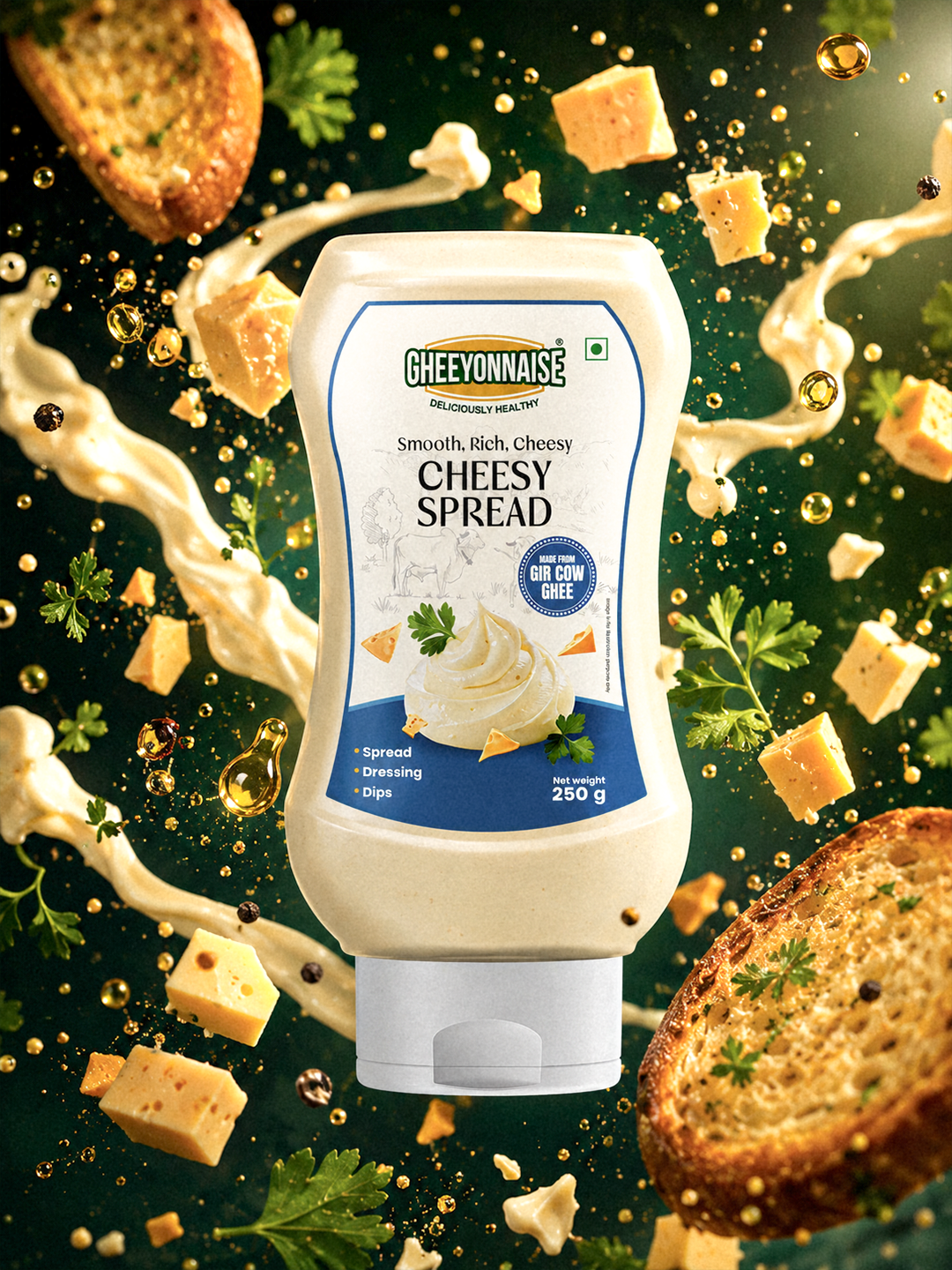
If you're curious about what a palm-oil-free spread tastes like, try Gheeyonnaise Classic Spread, made with 100% A2 Gir Cow Ghee. Or explore all five flavours and see the difference clean ingredients make.
"Pure ingredients make honest food. When you flip our jar, the first fat you'll see is A2 Gir Cow Ghee. No palm oil. No soya oil. No fine print."
- Kehul Shah, Founder, Gheeyonnaise
Want to understand the science behind ghee's nutritional profile? Read our deep-dive: Is Ghee Healthy? What Science Says in 2026.

0 comments