

Three Indian states have banned raw-egg mayonnaise in the space of twenty-seven months. Kerala moved first in January 2023. Telangana followed in October 2024, and Tamil Nadu in April 2025. Each order named the same reason: the risk of what grows in raw egg sitting at Indian room temperature.
That's an unusual amount of regulatory attention for a condiment. It also explains why "eggless mayo" has stopped being a niche request and started being a default one, asked in supermarket aisles and shouted across sandwich counters.
But the jar in your hand may say eggless on the front and still leave you guessing. What does the green mark actually certify? Can a product with no egg in it legally be called mayonnaise at all? And if there's no egg holding it together, what is? This guide answers those questions using India's own labelling law, a 2025 peer-reviewed study on egg-free emulsions, and the text of the state orders themselves.
Key Takeaways
- Under FSSAI law, egg is explicitly non-vegetarian, but milk products are explicitly excluded from that definition (FSS (Labelling and Display) Regulations, 2020, Reg. 2(1)(o)).
- Vegetarian is a green circle in a green square. Non-vegetarian is a brown triangle. Most people have this the wrong way round.
- 39% of Indian adults describe themselves as vegetarian, and 81% limit meat in some way (Pew Research Center, 2021).
- A 2025 study in Molecules found an aquafaba formulation beat egg yolk on emulsion stability and raised protein from 12.82% to 19.13%.
- Eggless doesn't mean healthier. The base oil matters far more than the absence of egg.
Why Does Eggless Mayo Matter So Much in India?
India has one of the largest vegetarian populations on earth. In 2021, the Pew Research Center found that 39% of Indian adults describe themselves as vegetarian and 81% limit meat in their diets in some way, based on 29,999 face-to-face interviews across 26 states in 17 languages (Pew Research Center, Religion in India: Tolerance and Segregation, June 2021).
One honest caveat about that number. Pew let people define "vegetarian" for themselves and never asked specifically about eggs. So it isn't a count of Indians who avoid eggs. It's a count of Indians for whom the question matters enough to shape how they describe their own diet.
The variation by community is where it gets interesting.
Most mayonnaise sold worldwide is built on egg yolk. In India, a sizeable share of the people reaching for that jar have a reason to check the label first.
Can Eggless Mayo Legally Be Called "Mayonnaise"?
In the United States, no. American law sets a standard of identity for mayonnaise that requires an egg-yolk-containing ingredient, alongside not less than 65% vegetable oil by weight and an acidifying ingredient (US Code of Federal Regulations, 21 CFR § 169.140). It's why egg-free products in American supermarkets are sold as "dressing" or "spread" rather than mayonnaise.
India works differently. FSSAI's labelling rules say that where a food is specified by an essential composition that establishes its identity, that prescribed name must be used, but "in the absence of such name, either a common or usual name or an accompanying description of true nature of food shall be used" (FSS (Labelling and Display) Regulations, 2020, Reg. 5(1)). Foods that aren't standardised under the regulations fall into a separate bucket the rules call proprietary food, defined as "an article of food that has not been standardised under these regulations."
The practical consequence is visible on every Indian shelf. Egg-free products are sold here as mayonnaise, under that name, without the legal contortion an American manufacturer has to perform. So a label reading "eggless mayonnaise" isn't a marketing fudge in India. It's a name the law permits.
What that means for you as a shopper: the word "mayonnaise" on an Indian jar tells you nothing whatsoever about whether there's egg inside. You cannot reason from the name. You have to read the mark and the ingredients, which is exactly what the next section covers.
How Do You Identify Eggless Mayo on the Shelf?
India gives you a legally mandated shortcut, and most people misremember how it works. Under FSSAI rules, the vegetarian symbol "shall consist of a green colour filled circle inside a square with green outline." The non-vegetarian symbol "shall consist of a brown colour filled triangle inside a square with brown outline" (FSS (Labelling and Display) Regulations, 2020, Reg. 5(4)).
Green is a circle. Brown is a triangle. Not a green triangle, and not the brown circle many of us grew up with, which belonged to the older 2011 rules.

Why Ghee Keeps the Green Mark but Egg Never Can
Now the part that decides everything for mayonnaise. FSSAI defines non-vegetarian food as an article containing any animal, bird, insect, fish "or eggs or products of any animal origin, but does not include milk, milk products, honey or bees wax or carnauba wax or shellac" (Reg. 2(1)(o)).
Read that carefully, because it settles two arguments at once. Egg is unambiguously non-vegetarian under Indian law, so there's no statutory "eggetarian" middle ground on a label. And milk products are carved out by name, which is why a dairy-based spread carries the green circle by regulation rather than by claim.
Three More Things the Law Puts on Your Side
Beyond the symbol itself, the regulations give you three further handholds:
- Placement is mandated. The symbol must appear "on principal display panel, just close in proximity to the name or brand name of the product on front of pack" (Reg. 5(4)(d)). You shouldn't have to hunt for it.
- Egg is a declared allergen. "Eggs and egg products" must be declared on the label (Reg. 5(14)(iv)). Look for a "Contains Egg" line, and note that a dairy-based product will carry "Contains Milk" instead.
- Restaurants are covered too. Food service establishments must display the veg or non-veg logo on menu cards and boards (Reg. 9(2)(b)), so the question is fair to ask at a sandwich counter.
If you want to go further than the symbol and actually decode what's in the jar, our guide to reading condiment labels in India walks through the ingredients list line by line.
Why Three Indian States Banned Raw-Egg Mayonnaise
This is the shift most people haven't registered. Between January 2023 and April 2025, three state governments prohibited raw-egg mayonnaise outright, each invoking Section 30(2)(a) of the Food Safety and Standards Act, 2006 (News on AIR, Prasar Bharati, October 2024).
Telangana's Commissioner of Food Safety prohibited the production, sale and storage of mayonnaise prepared from raw eggs for one year with immediate effect, under Section 30(2)(a) of the Act (News on AIR, Prasar Bharati, October 2024). Tamil Nadu's notification, effective 8 April 2025, named the pathogens it was worried about: Salmonella Typhimurium, Salmonella Enteritidis, E. coli and Listeria monocytogenes (The South First, April 2025).
Kerala's order carried the detail that matters most here. It banned mayonnaise made with raw eggs while explicitly exempting vegetable-based eggless mayonnaise and mayonnaise made with pasteurised eggs (Onmanorama, January 2023). A state food-safety authority, acting on a public-health problem, named egg-free mayonnaise as part of the solution.
None of this means egg-based mayo from a reputable manufacturer is dangerous. Commercial producers use pasteurised egg, and pasteurisation is precisely what these orders treat as acceptable. The risk sits with raw egg in warm conditions, which is a real and specifically Indian retail problem.
What Replaces the Egg?
Egg yolk does a specific job in mayonnaise. Its lecithin is an emulsifier, persuading oil and water to stay combined instead of separating. Remove the yolk and something else has to do that work, usually a protein source plus a hydrocolloid gum. Aquafaba, the viscous liquid from cooked chickpeas, has become the most studied option. In 2025, a peer-reviewed study in Molecules tested egg-free mayonnaise stabilised with aquafaba and gum tragacanth against a 15% egg-yolk control, and the best formulation reached a physical stability of 96.08 and heat stability of 95.96, outperforming the egg-yolk control on both, while raising protein content from 12.82% to 19.13% (Shafique et al., Molecules, August 2025).

Other systems appear across the literature, including rice protein with xanthan gum (Food Science and Biotechnology, 2024) and legume proteins paired with natural gums (Food and Bioprocess Technology, 2025). Commercially you'll also meet soy protein isolate, modified starch, guar gum and milk protein.
Where a spread is built on ghee rather than a liquid oil, the dairy solids and the fat's own structure contribute to body and mouthfeel, which is part of why a ghee base behaves differently from a refined-oil one. We go into that comparison properly in ghee vs seed oils in mayo.
Does Eggless Automatically Mean Healthier?
No. Eggless mayonnaise is not inherently healthier than egg-based mayonnaise. Mayonnaise is mostly oil by weight, and the American standard of identity sets a floor of not less than 65% vegetable oil (US Code of Federal Regulations, 21 CFR § 169.140). Removing the egg changes the vegetarian mark and the allergen line. It doesn't change the base fat.
So an eggless mayo built on refined palm oil is not nutritionally superior to an egg-based one built on olive oil. It's just egg-free. Those are different claims, and packaging often blurs them deliberately.
What we look at first: when we're assessing any spread, egg status is the third question, not the first. The first is what fat it's built on. The second is how many ingredients you can't pronounce. Egg comes after both, because the base fat is the majority of what you're actually eating.
Egg-Based vs Eggless: What Actually Differs
| What differs | Egg-based mayo | Eggless mayo |
|---|---|---|
| What holds the emulsion | Lecithin in egg yolk | Plant or milk protein, plus a gum |
| FSSAI mark on pack | Brown triangle (non-vegetarian) | Green circle (vegetarian) |
| Allergen declared | Contains Egg | Contains Milk, if dairy-based |
| State raw-egg bans | Restricted if made with raw egg | Exempted in Kerala’s order |
| Base fat | Usually refined seed or palm oil | Also usually refined oil, unless stated |
| Nutritionally better? | Depends on the base fat | Also depends on the base fat |
The bottom row is the one that matters. Taking the egg out changes the mark on the pack and the allergen line. It doesn’t change the oil.
Three Checks Before You Buy
- Find the green circle. Front of pack, close to the brand name. That settles the egg question in a second.
- Read the first two or three ingredients. They are listed in descending order by weight, so they tell you what the jar is mostly made of.
- Count the additive codes. A long run of INS numbers tells you how much work is going into shelf life.
If the first ingredient is "edible vegetable oil" with no further detail, you've learned something. Why palm oil in mayo should concern you covers why that particular phrase hides so much.
That matters most for the jars that end up in children's food, which is the test our roundup of healthier spreads for kids' lunchboxes in India applies across categories.
Frequently Asked Questions
Is eggless mayo the same as vegan mayo?
No. Eggless means no egg. Vegan means no animal-derived ingredient at all, which also rules out milk, ghee, butter and honey. Under FSSAI's definition, milk products are excluded from the non-vegetarian category, so a dairy-based spread is legally vegetarian and carries the green circle, but it is not vegan.
Is Gheeyonnaise eggless?
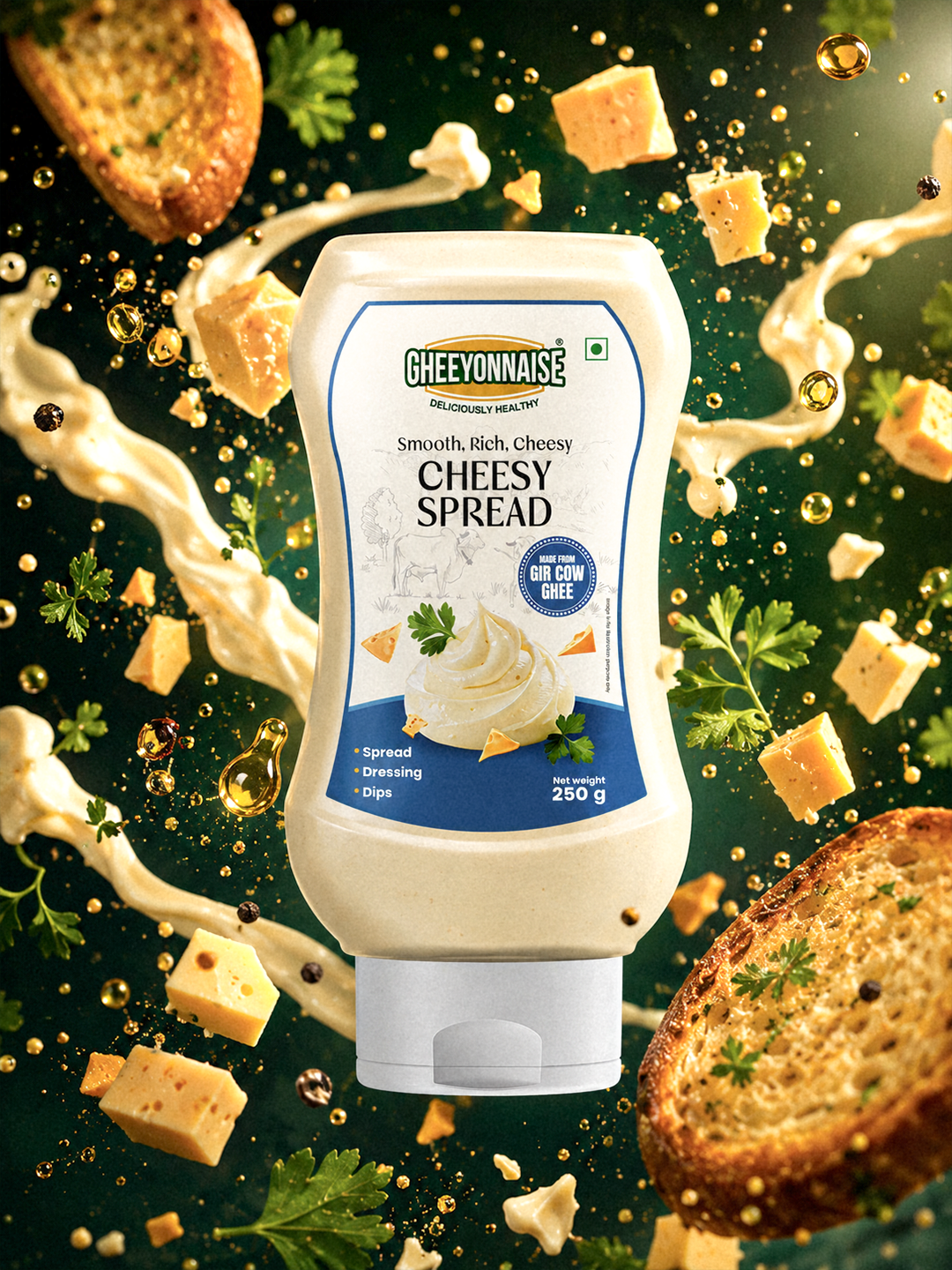
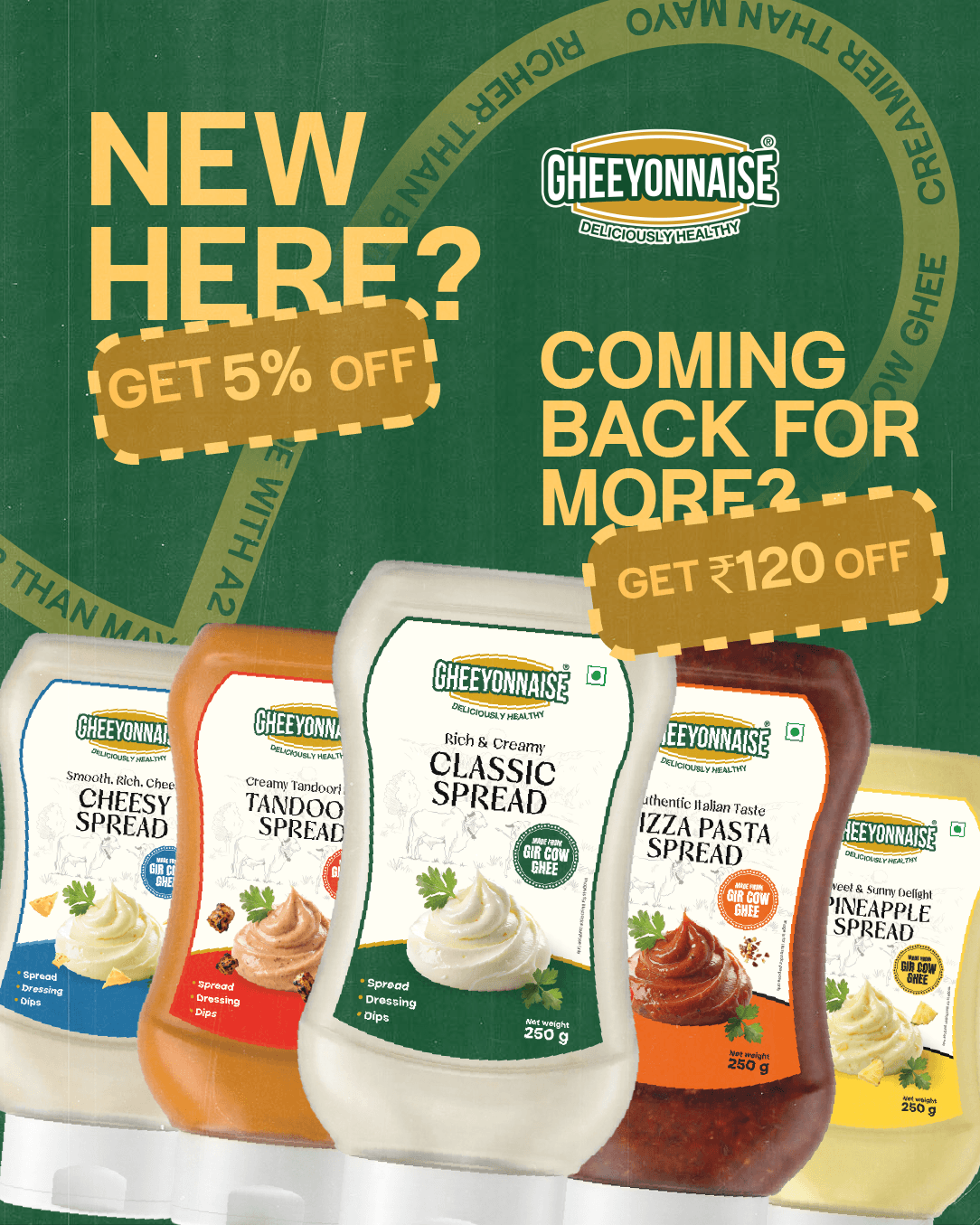
Yes. Our Classic Spread and the rest of the range are 100% vegetarian and eggless, built on A2 Gir Cow Ghee rather than egg yolk or refined seed oil. It declares "Contains Milk" as its allergen, since ghee is a milk product. It is vegetarian but not vegan, for the reason described in the previous answer.
What does the green dot on Indian food packaging actually mean?
It certifies the product contains no non-vegetarian ingredient as FSSAI defines the term, which explicitly includes eggs and excludes milk products. The symbol is a green filled circle inside a green-outlined square, and regulations require it on the front of pack close to the brand name. It says nothing about nutritional quality.
Why did Indian states ban raw-egg mayonnaise?
Because of pathogen risk in raw egg held at ambient temperature. Tamil Nadu's April 2025 notification named Salmonella Typhimurium, Salmonella Enteritidis, E. coli and Listeria monocytogenes. Kerala, Telangana and Tamil Nadu have all issued orders since January 2023. Kerala's exempted eggless and pasteurised-egg mayonnaise explicitly.
What to Take to the Shop
Eggless mayo in India is no longer a compromise product made for a minority. Three state governments have pushed the market toward it on safety grounds, the research suggests egg-free emulsions hold up as well as egg-based ones, and the law puts a green circle on the front of every pack to settle the question in a second.
What the law won't tell you is what the mayo is made of. Find the circle, then turn the jar around and read the first three ingredients. That's where the real difference between one eggless mayo and another lives.
If you'd like a spread that answers both questions the same way, explore the full range of Gheeyonnaise spreads, each one eggless, built on 100% A2 Gir Cow Ghee, with no palm oil, no soya oil and no preservatives.
Questions about ingredients, labelling, or what goes into our products? Write to us at gheeyonnaise@riksglobal.com.
— Kehul Shah, Founder, Gheeyonnaise
Updated September 2026
0 comments