

Mayonnaise has a legal definition, and it's stricter than you'd think. Under the US standard of identity, mayonnaise must contain at least 65% vegetable oil by weight and must include an egg yolk ingredient (21 CFR 169.140, Mayonnaise). A ghee-based spread breaks both rules. That's why it sits in a different category.
In 2025, IMARC Group valued India's mayonnaise market at USD 455.66 million, projecting USD 850.06 million by 2034 at a 6.20% CAGR (IMARC Group, India Mayonnaise Market, 2025). Nearly all of that volume is refined-oil mayo.
Set ghee mayo vs regular mayo side by side and the base oil is only part of the story. We covered that ground in ghee vs. seed oils in mayo. This post compares the finished jar: the label, the nutrition panel, and whether the price gap holds up.
Key Takeaways
- Regular mayonnaise carries 681 calories, 75g fat, and 635mg sodium per 100g (USDA FoodData Central 171009).
- The real gap is the ingredient list, not the calorie count. Both are fat-dense and salted.
- Ghee carries roughly 606 micrograms of vitamin A per 100g (ScienceDirect, 2024); refined-oil mayo has about 16.
- Eggless doesn't mean allergen-free. A ghee base contains milk instead.
How Do Ghee Mayo and Regular Mayo Differ at a Glance?
The two differ most on ingredient list, egg content, and price, and barely at all on calories. In 2025, IMARC found institutional buyers like restaurants and cloud kitchens drove 54.2% of India's mayonnaise end use (IMARC Group, 2025). Bulk economics shape most jars.
| Category | Ghee-Based Spread | Regular Mayonnaise |
|---|---|---|
| Base fat | A2 Gir Cow Ghee | Refined vegetable oil (min. 65% by weight) |
| Egg | None (eggless) | Egg yolk required by standard |
| Ingredient list | 3 lines | Typically 10 or more, with INS codes |
| Preservatives | None | Commonly present |
| Sequestrants (EDTA) | None | Permitted and widely used |
| Calories per 100g | High (ghee is 876 kcal/100g neat) | 681 kcal |
| Allergen | Milk | Egg (and often soy) |
| Relative price | Premium (~2-2.5x) | Cheaper |
| Our verdict | Wins on label & nutrients | Wins on price |
Notice what's missing: a meaningful calorie gap. Both are mostly fat.
What's Actually on the Label?
The ingredient list is where these two diverge most sharply. The mayonnaise standard permits a long list of optional additions. Monosodium glutamate, nutritive sweeteners, crystallisation inhibitors, and sequestrants including calcium disodium EDTA, which "may be used to preserve color and/or flavor" (21 CFR 169.140).
Read a mainstream Indian mayo label and you'll find a similar cast: refined oil, water, sugar, starch, salt, an acidity regulator, a stabiliser, a preservative, a sequestrant. None of it is hidden or illegal. It's what industrial shelf stability requires.

Our own label reads differently by design. Gheeyonnaise Classic Spread lists A2 Gir cow ghee, iodised salt, and spices and condiments. It declares 0g trans fat, uses no preservatives, and is 100% vegetarian and eggless.
Here's the honest trade-off. Skipping preservatives shortens the clock: our pack says use within one month of opening. And eggless isn't allergen-free, since ours declares "contains milk." The allergen swaps rather than vanishes, which is why reading condiment labels properly beats trusting front-of-pack claims. Label rules are tightening anyway: the Food Safety and Standards (Labelling and Display) First Amendment Regulations, notified in March 2026, take effect on 1 July 2027 (FSSAI, Labelling and Display amendments).
The US standard of identity for mayonnaise permits monosodium glutamate, nutritive sweeteners, crystallisation inhibitors, and EDTA sequestrants as optional ingredients (21 CFR 169.140). A ghee-based spread avoids these by using clarified butter, salt, and spices alone, at the cost of a shorter open-jar shelf life.
Verdict: Ghee-based spreads win on label simplicity. Regular mayo wins on shelf life after opening.
How Do the Nutrition Numbers Compare?
Calories are close; micronutrients are not. Regular mayonnaise delivers roughly 681 calories, 75g of total fat, 12g of saturated fat, and 635mg of sodium per 100g, with only about 16 micrograms of vitamin A (USDA FoodData Central, entry 171009). Ghee carries around 606 micrograms.
That gap comes from processing, not magic. A 2024 analysis found ghee supplies roughly 606 micrograms of vitamin A and 1,650 micrograms of vitamin E per 100g, plus 4 to 5 grams of butyric acid and 0.4 to 0.7 grams of conjugated linoleic acid (ScienceDirect, Nutritional composition of ghee, 2024). Refining strips seed oils of most comparable micronutrients.
Butyric acid is the one worth knowing about. It's a short-chain fatty acid that may support the gut lining, and ghee is among the richest dietary sources. Ghee also carries vitamin K2, involved in how the body handles calcium.
Now the counterweight. Ghee is about 62% saturated fat by weight (USDA FoodData Central, butter oil / ghee, entry 173412), and the evidence on ghee and cardiovascular health is mixed rather than settled. Regular mayo is lower in saturated fat, though most of its fat is oxidation-prone polyunsaturated oil. Managing cholesterol? Talk to your healthcare provider first.
Regular mayonnaise provides about 681 calories, 75g fat, and 635mg sodium per 100g, with roughly 16 micrograms of vitamin A (USDA FoodData Central 171009). Ghee supplies around 606 micrograms of vitamin A and 4 to 5 grams of butyric acid per 100g (ScienceDirect, 2024).
Verdict: Ghee-based spreads win on micronutrients. Regular mayo wins narrowly on saturated fat.
What About Sodium and the Ultra-Processed Question?
Sodium is the number most people ignore, and India already has a problem with it. In July 2025, the ICMR National Institute of Epidemiology reported average salt intake of about 9.2 grams per day in urban India and 5.6 grams in rural India, against a WHO recommendation of under 5 grams (Business Standard, ICMR salt intake study, July 2025). At 635mg of sodium per 100g, mayo is a quiet contributor.
Here's the part worth sitting with: a ghee-based spread isn't low-sodium either. Ours lists iodised salt second, because salt is what makes a savoury spread savoury. On sodium the two are comparable, and portion size matters more than brand.
Where they genuinely part ways is processing. In November 2025, a Lancet series reported that India's ultra-processed food retail sales rose from USD 0.9 billion in 2006 to nearly USD 38 billion in 2019 (The Lancet, Ultra-processed foods: time to put health before profit, 2025). That's a fortyfold jump, and the series links it to rising obesity and type-2 diabetes.
Our take: One condiment won't undo a fortyfold rise in ultra-processed food. Sodium you can manage by using less. Additives you can only manage by choosing differently.
In November 2025, a Lancet series reported India's ultra-processed food retail sales grew from USD 0.9 billion in 2006 to nearly USD 38 billion in 2019 (The Lancet, 2025). Separately, ICMR-NIE found urban Indian salt intake averaging 9.2 grams daily against a WHO limit of under 5 grams (Business Standard, 2025).
Verdict: A draw on sodium. Ghee-based spreads win on additive load.
Does the Price Difference Make Sense?
Price is regular mayo's strongest argument, though the gap per sandwich is smaller than the gap per jar. Premium ghee-based spreads sell at roughly 2 to 2.5 times mainstream mayo, driven almost entirely by the base ingredient. India's ghee market was valued at INR 3,774.5 billion in 2025, projected to reach INR 7,532.7 billion by 2034 (IMARC Group, Ghee Market in India, 2025).
What we found when we costed it: A 250g jar works out to roughly Rs 15 for a 15g sandwich serving, against Rs 6 to 7 for mainstream mayo. Per jar the premium looks steep. Per sandwich it's under Rs 10.
So is the premium worth it? If mayo is an occasional party dip, probably not. If it goes into lunchboxes four days a week, the per-serving gap starts to look like a fair price for a shorter ingredient list.
Verdict: Regular mayo wins on price. Ghee-based spreads win on value per serving for regular users.
Frequently Asked Questions
Is ghee mayo lower in calories than regular mayonnaise?
No, and any brand claiming otherwise is stretching it. Regular mayonnaise runs about 681 calories per 100g, and neat ghee is denser still at 876 (USDA FoodData Central, entries 171009 and 173412). The difference is what comes along with those calories, not how many there are.
Is ghee-based mayo eggless?
Yes. Because the standard definition of mayonnaise requires egg yolk (21 CFR 169.140), a spread built on clarified butter, salt, and spices is eggless by construction. Gheeyonnaise Classic Spread is 100% vegetarian and eggless, though it does contain milk.
Why does ghee-based mayo need to be used faster once opened?
No preservatives means a shorter clock once air gets in. Regular mayo commonly carries a preservative plus an EDTA sequestrant to hold colour and flavour (21 CFR 169.140). Our pack advises using it within one month of opening. That's the honest cost of a three-ingredient label.
Does a ghee base taste different from regular mayo?
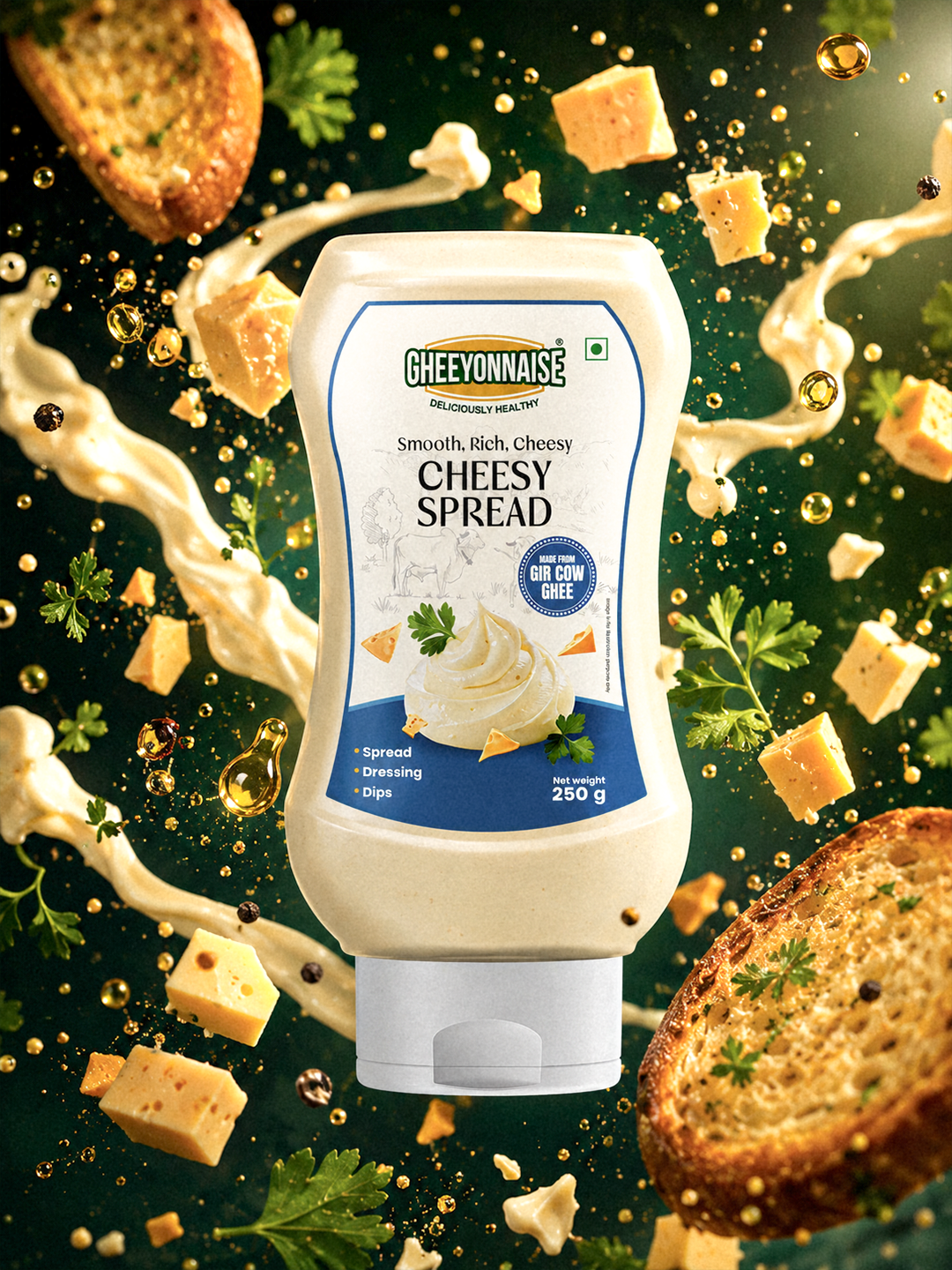
Yes, noticeably. Refined oil is chosen partly for being flavour-neutral, so regular mayo carries added seasoning cleanly. Ghee brings its own warm, faintly nutty richness, which is why our Cheesy Spread tastes fuller than a standard jar.
The Bottom Line
Set the two side by side and the pattern holds. Calories tie, sodium ties, price favours one, and the ingredient list favours the other.
| Category | Winner |
|---|---|
| Label simplicity & additives | Ghee-based spread |
| Micronutrients | Ghee-based spread |
| Eggless suitability | Ghee-based spread |
| Calories & sodium | Draw |
| Shelf life after opening | Regular mayonnaise |
| Price | Regular mayonnaise |
| Overall | Ghee-based spread (for everyday use) |
Regular mayo earns its shelf space on price, and for occasional use that's fair. But if a condiment is part of your week rather than your party, a three-ingredient label built on a fat with real nutritional history is the better pick.
Want to taste the difference the base makes? Try Gheeyonnaise Classic Spread, made with 100% A2 Gir Cow Ghee, or explore the full Gheeyonnaise range.
"We couldn't legally call it mayonnaise, because we wouldn't put refined oil or egg in it. Losing the word was worth keeping the label to three lines."
- Kehul Shah, Founder, Gheeyonnaise
Health-adjacent note: this article is educational and not medical advice. Both products are calorie-dense, salted fats. Consult your healthcare provider for guidance specific to your health.
Want the chemistry behind the base fat? Read Ghee vs. Seed Oils in Mayo, or see Why Palm Oil in Mayo Should Concern You.

0 comments