

Here's something most Indians don't know about their own cattle. Roughly 80% of the milk produced in Brazil comes from a breed descended from cows that left Gujarat in the 1940s. The Gir travelled halfway around the world and became the backbone of a foreign dairy industry. Back home, meanwhile, it has been losing ground for decades.
That contradiction is the real story behind Gir ghee, and it raises a fair question: does the breed actually change the ghee, or is "Gir" just a word that justifies a higher price? After three generations of making ghee, I think the honest answer sits between the two.
Key Takeaways
- Gir cows average 2,110 kg of milk per lactation at 4.6% fat (NDDB) - less milk than exotic breeds, but richer.
- That fat-for-volume trade-off is the whole case for Gir ghee.
- Brazil's Girolando, three-eighths Gir, now yields 80% of Brazil's milk.
- India's indigenous cattle fell 6% from 2012 to 2019; crossbreds rose 26.9%.
- The golden colour is tradition, not published data.
What Exactly Is a Gir Cow?
The Gir is an indigenous Bos indicus breed from the Saurashtra region of Gujarat, named after the Gir forest where it originated (NDDB Dairy Knowledge Portal, Gir breed profile). It's built for a climate that would flatten a European dairy cow.

You can identify one without a pedigree certificate. Gir cattle are red, sometimes speckled, with a domed convex forehead and long pendulous ears folded like a leaf. In 2020, a survey of Indian Gir herds put adult cows at about 313 kg (Sabapara et al., Physical Characteristics and Production Performance of Gir Cattle in India, International Journal of Livestock Research, 2020).
Those features aren't for show. The loose skin, ears and hump all help shed heat. The breed handles Indian summers, local fodder and regional disease pressure in ways imported high-yield breeds don't. That toughness is why the breed lasted centuries before anyone thought to put it on a label.
What Do the Milk Numbers Actually Say?
In 2026, the most widely cited breed figures come from India's National Dairy Development Board: Gir cows average 2,110 kg of milk per lactation with an average fat content of 4.6%, ranging from 3.9% to 5.1% (NDDB Dairy Knowledge Portal, Gir breed profile). Yield varies enormously by herd, from roughly 800 kg to over 3,000 kg.
Field data agrees. Analysis of 1,118 Gir lactations in Gujarat between 2012 and 2015 found a mean 305-day yield of 2,573 kg, with individual animals ranging from 752 kg to 5,956 kg (Sabapara et al., 2020). "Gir" describes a breed, not a guaranteed output.
In 2021, a peer-reviewed ICAR study tracked Gir cattle in hot, humid Tamil Nadu across 5,130 test-day records, finding a total lactation yield of 1,507 kg at 5.05% fat and 7.65% solids-not-fat (Indian Journal of Animal Sciences, Test day yield and production potential of Gir cattle, 2021). Lower yield, higher fat. That richer fat is also where ghee's butyric acid content sits.
How does Gir compare with exotic dairy breeds?
| Trait | Gir (indigenous) | Jersey (exotic) | Holstein Friesian (exotic) |
|---|---|---|---|
| Lactation yield | 900-1,600 kg | 5,000-8,000 kg | 7,200-9,000 kg |
| Milk fat | 4.6% (3.9-5.1%) | Higher than HF | ~3.9% |
| Ghee per litre of milk | Most | Middle | Least |
| Heat and humidity | Native tolerance | Struggles | Struggles |
| Bred for | Richness and survival | Volume | Volume |
Yield figures for all three breeds come from a single source for consistency (ICAR-CCARI, breeds of dairy cattle). Note its Gir range runs lower than the NDDB breed average of 2,110 kg quoted above, which is exactly the spread this section is about. Gir fat from NDDB Dairy Knowledge Portal, Gir breed profile; Holstein Friesian fat of 38.6 g/kg from a 2022 peer-reviewed low-input herd study (Journal of Dairy Research, 2022).
That's the pattern worth understanding. These cows don't out-produce exotic dairy breeds on volume, and nobody serious claims they do. Those breeds were selected for litres; Gir was selected by Indian conditions for survival and richness.
Ghee is made from milk fat, so a higher fat percentage means more ghee per litre. That's the case for the breed as a ghee source, and it's the same arithmetic that separates ghee from butter on composition. It isn't a health claim, it's a yield-composition trade-off, and it's why this ghee costs more to make.
How Did an Indian Breed End Up Behind 80% of Brazil's Milk?
Starting in the 1940s, Brazilian breeders crossed imported Gir cattle with Holsteins, and the resulting Girolando breed was formally standardised in 1989 by Brazil's Ministry of Agriculture at 5/8 Holstein to 3/8 Gir. As of 2026, Girolando accounts for roughly 80% of Brazil's milk production (The Cattle Site, Girolando breed profile).
The founding story, widely reported in Indian media, is that the Maharaja of Bhavnagar gifted a small herd of Gir cows to Brazil in the 1940s. Brazilian breeders spelled it "Gyr" and went to work.
What were they after? Holsteins produce spectacular volumes of milk but struggle with tropical heat, humidity and parasites. Gir handles all three. Cross the two and you get European yield genetics carried on an animal that can actually survive a tropical summer.
What does Brazil's success say about the breed?
Brazil kept investing. In 1997 Embrapa, the country's agricultural research corporation, formalised a Girolando breeding programme with the breeders' association, selecting across dozens of economic traits (The Cattle Site, Girolando breed profile).
Here's the part that should sting. India spent those same decades moving the other way, importing exotic genetics to raise yields while indigenous breeds thinned out. Brazil treated the Gir as a genetic asset worth fifty years of investment. We treated it as something to upgrade away from.
That isn't a claim that Gir is secretly the world's best dairy cow. Brazil's success came from crossing Gir, not farming it pure. But it's strong evidence the breed carries real traits, proven out by an industry with no reason to flatter Indian cattle.
Why Is Gir Ghee Golden? An Honest Answer
The deep gold of desi ghee is traditionally attributed to beta-carotene in the milk fat of indigenous zebu cattle. But I couldn't find a single published, breed-specific measurement comparing carotenoid levels in Gir milk fat against crossbred milk fat. So I'm not going to give you a number.

What's established is narrower. Carotene levels in milk fat shift with diet, above all green fodder, and with season. Cows grazing fresh pasture produce yellower fat than cows on dry feed, regardless of breed. So when ghee comes out a richer gold, the most defensible explanation is what the animal ate and when, alongside breed genetics that probably contribute but haven't been isolated in published work.
Why say this when it undercuts an ingredient we sell? Because the ghee category is drowning in confident numbers nobody can source. If we ask people to pay more for A2 Gir cow ghee, they deserve to know which parts rest on evidence and which rest on tradition. Colour is tradition. The fat percentage is evidence.
Is the Gir Breed Actually at Risk?
India's 20th Livestock Census in 2019 counted 192.49 million cattle: 142.11 million indigenous and non-descript, against 50.42 million exotic and crossbred. Indigenous cattle numbers had fallen 6% since the 2012 census, while exotic and crossbred cattle rose 26.9% (Department of Animal Husbandry & Dairying, 20th Livestock Census, 2019).
Read those together. Indigenous cattle still make up roughly three-quarters of India's herd, so this isn't an endangerment story. It's a direction-of-travel story, and the direction has been consistent. The logic makes sense: a farmer paid per litre picks the animal that gives more litres, and nobody should blame dairy farmers for responding to how the market pays them.
But it matters for anyone buying ghee. Demand for real desi-breed ghee is one of the few signals that makes keeping Gir herds pay. India's ghee market reached INR 3,774.5 billion in 2025 and is projected to hit INR 7,532.7 billion by 2034 (IMARC Group, Ghee Market in India, 2025). Where that money flows shapes which cows exist in twenty years.
How Do You Verify You're Buying Real Gir Ghee?
You largely can't verify breed from a label alone, and that's the uncomfortable truth of this category. In 2025 India's premium A2 ghee segment was worth INR 1.28 billion and is forecast to reach INR 9.51 billion by 2034, a 21.41% CAGR (IMARC Group, India A2 Ghee Market, 2025). A market growing that fast attracts claims faster than it attracts proof.
No consumer-facing test distinguishes Gir milk fat from crossbred milk fat in a finished tin. Breed claims rest on one thing only: whether the seller can trace the milk.
Regulators are watching. In August 2024 the FSSAI told food businesses to remove A1 and A2 claims from milk-product labelling, then withdrew the advisory within days pending consultation (Business Standard, August 2024). No final rule has been confirmed since, so breed claims sit in a grey zone rather than under a settled standard.
Four checks to run before you buy
Work through these in order. The licence number is the one claim on the pack you can independently check (FSSAI).
- Ask where the milk comes from. A brand that names its sourcing region and herd arrangement is making a checkable claim. One that only says "A2 Gir" on the front is making a decorative one.
- Check the FSSAI licence number on the pack, and look at the manufacturer behind the brand.
- Distrust prices that don't add up. Gir ghee is expensive because the yield is genuinely lower. Bargain "Gir ghee" is a contradiction.
- Read the full ingredient panel, not the front of pack. Our guide to reading condiment labels in India walks through what the small print actually tells you.
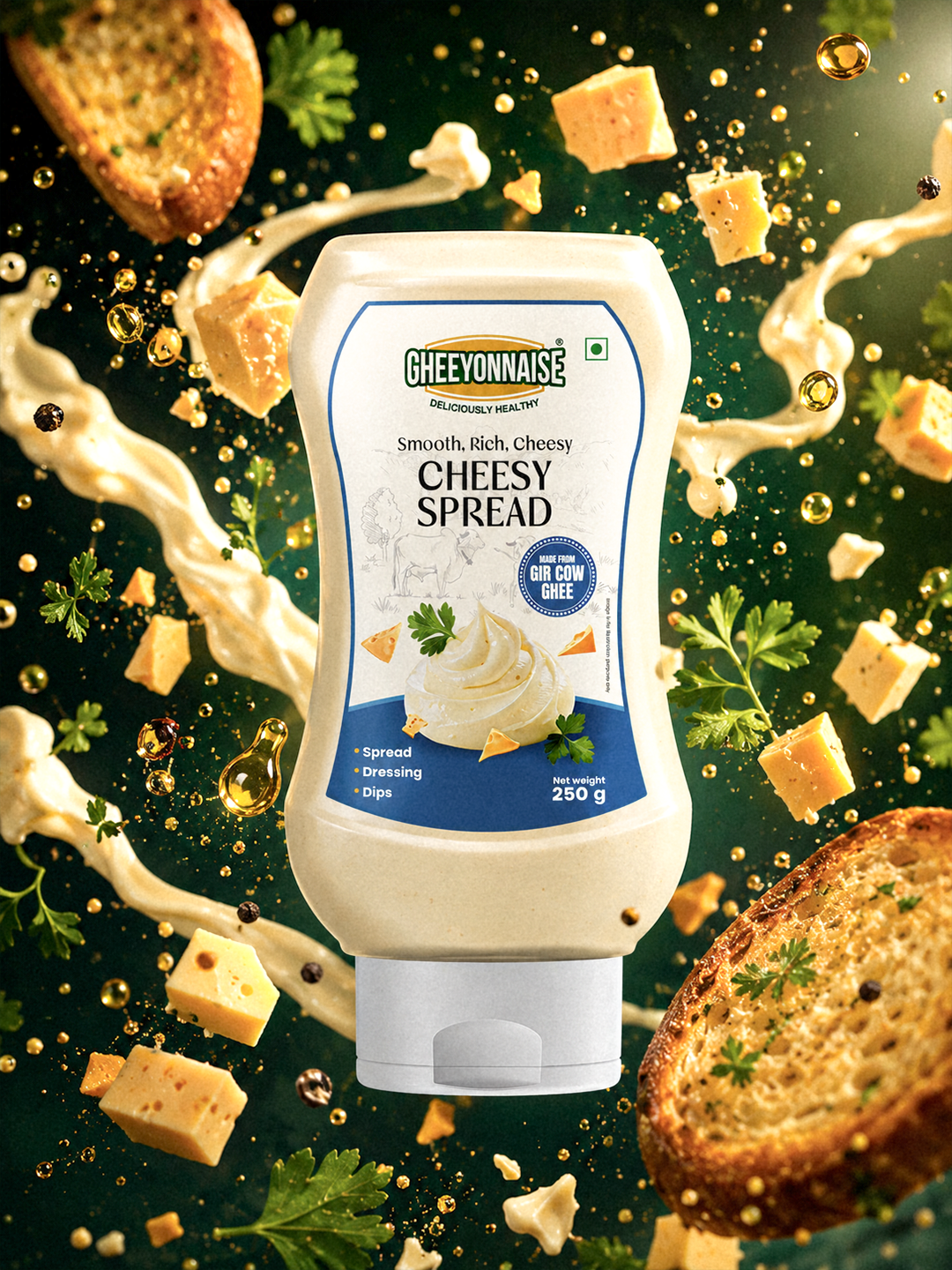
We use A2 Gir cow ghee as the base for every Gheeyonnaise Classic Spread, and the hardest part of the business is exactly this: securing consistent Gir supply at consistent quality. Ghee-making is the easy half. Provenance is the expensive half, and it's invisible to the person holding the jar. That's precisely why so many labels claim it. For the protein-level detail, see A2 Ghee vs Regular Ghee.
Frequently Asked Questions
How much milk does a Gir cow give per day?
It varies widely by herd and climate. Breed data puts Gir at an average 2,110 kg per lactation (NDDB Dairy Knowledge Portal, Gir breed profile). A 2021 ICAR study in hot, humid Tamil Nadu recorded a daily test-day average of 5.78 litres, peaking at 9.23 kg around day 46. Well-managed elite herds do considerably better.
Is Gir cow ghee better than regular ghee?
Gir milk carries a higher fat percentage, averaging 4.6% in NDDB breed data and reaching 5.05% in a 2021 ICAR study, which means more ghee per litre and a richer raw material. That's a real compositional difference. It is not evidence of a medical benefit, and no breed of ghee treats or prevents disease.
Why is Gir cow ghee so expensive?
Because the economics are genuinely harder. In studies published between 2020 and 2021, Gir cows yielded roughly 1,500 to 2,600 kg per lactation depending on conditions, well below exotic dairy breeds selected for volume. Lower yield plus traceable single-breed sourcing means higher cost per litre, and that carries through to the finished ghee.
Is the golden colour proof my ghee is from desi cows?
No. Colour tracks green-fodder intake and season as much as anything else, and no published study isolates carotenoid levels in Gir milk fat against crossbred milk fat. A deep gold tin tells you about diet and processing. It doesn't verify breed.
The Bottom Line
The Gir earns its reputation on composition, not mythology: higher fat per litre, lower yield, real heat resilience, and a genetic value so evident that Brazil built a dairy industry partly on it. Those are checkable facts.
What doesn't hold up is the folklore around it, the precise carotene figures and the colour-as-proof test. Strip those away and the case for Gir ghee is still solid, just narrower than the category usually admits. Buy it because the milk is richer and because demand keeps indigenous herds viable. Ask where it comes from, expect to pay what lower yields cost, and be sceptical of numbers nobody can source.
If you'd like to taste what A2 Gir cow ghee does as a base rather than a topping, try our Classic Spread, or explore the full Gheeyonnaise range.
"People assume the hard part of our business is making the ghee. It isn't. The hard part is knowing, with certainty, which cows the milk came from. Everything else is technique. That one is trust."
- Kehul Shah, Founder, Gheeyonnaise
Health-adjacent note: this article is educational and not medical advice. Ghee of any breed is high in saturated fat. Consult your healthcare provider for guidance specific to your health.
Want more on what's actually inside ghee? Read Is Ghee Healthy? What Science Says in 2026.

0 comments