

The history of ghee in India begins about 400 kilometres from the factory where we make our spreads, in broken cooking pots with fat still trapped in the clay. In 2020, a team writing in Scientific Reports analysed 59 ceramic sherds from Kotada Bhadli in Kachchh, Gujarat. At least five carried the chemical fingerprint of ruminant dairy fat (Chakraborty et al., Compound specific isotope analysis of lipid residues provides the earliest direct evidence of dairy product processing in South Asia, Scientific Reports, September 2020). The settlement was occupied between 2300 and 1950 BCE.
Here's what bothers me about how this story usually gets told. Indians are often informed that we moved away from ghee because modern nutrition science caught up with it. That isn't what the record shows. We moved away because ghee got expensive, a cheaper look-alike arrived, and that look-alike was marketed brilliantly.
My family has been making ghee for three generations, and our parent company has manufactured it commercially since 2007. I've watched the tail end of this shift from inside the industry. What follows is the actual sequence: four thousand years of continuity, one fifty-year interruption, and a return that's happening faster than most people realise.
Key Takeaways
- The earliest chemically confirmed dairy processing in South Asia comes from Kachchh, Gujarat, dated 2300–1950 BCE (Scientific Reports, 2020).
- Indians didn't abandon ghee on medical advice. Vanaspati arrived in 1937 at a fraction of ghee's price and held a near-monopoly until the 1980s.
- Trans fat in vanaspati once ran as high as 50–60% of total fat. India capped it at 2% only in January 2022.
- India's A2 ghee segment is growing at 21.41% a year against 7.70% for ghee overall — the comeback is about provenance, not volume.
What Does the Earliest Evidence of Ghee in India Actually Show?
It shows deliberate processing, not just milk-drinking. In 2020, researchers publishing in Scientific Reports took 59 pottery fragments from Kotada Bhadli, carried 21 of them through compound-specific isotope analysis, and securely identified at least five as holding ruminant dairy fat (Chakraborty et al., Scientific Reports, vol. 10, article 16095, September 2020). The site sits in Nakhatrana taluka, Kachchh, and was occupied between 2300 and 1950 BCE.

The distinction matters more than it sounds. Fresh milk leaves a different trace than milk that's been heated, soured, or rendered. Absorbed lipids in porous clay mean the vessel was used repeatedly for a fatty dairy product, which points to processing rather than casual consumption.
And there's a reason processing would have mattered so much here. Kachchh is hot and dry. Fresh milk spoils within hours in that climate, and there was no refrigeration for another four thousand years. Rendering butterfat until the water is gone was, in practical terms, India's earliest food-preservation technology. Ghee wasn't invented as a luxury. It was invented as a way to keep calories alive through a Gujarat summer.
That the earliest hard evidence sits in Gujarat isn't lost on me. Our own ghee is made a few hours' drive from that dig site. Regional continuity of this length is rare in food, and it's worth taking seriously when you read a label that says "traditional method". For the difference the source animal makes, we've covered how A2 Gir cow ghee compares to regular ghee in detail.
Why Did Ancient India Treat Ghee as More Than Food?
Because it was simultaneously a preservative, a medicine, and a ritual offering. Ghrita appears throughout Vedic ritual as the offering poured into fire during yajna. Classical Ayurvedic literature goes further and treats it as a substance in its own right, not a cooking medium. The Charaka Samhita describes ghrita as a rasayana suitable for daily use. The later Bhavaprakasha calls it yogavahi — a carrier able to take on and transmit the properties of whatever is prepared with it (Journal of Ayurveda and Integrated Medical Sciences, A Critical Review on Go-Ghrita, Shata Dhouta Ghrita and Sahasra Dhouta Ghrita).
Read that yogavahi idea again, because it's genuinely clever. Classical physicians had noticed something we'd now describe in terms of fat solubility: certain compounds dissolve into fat and travel with it. They built an entire class of medicated preparations on that observation, centuries before anyone could measure it.
Ritual use also did something quietly practical. A substance offered to fire in every major household ceremony had to be available in every household, which kept small-scale ghee-making alive across regions and income levels for millennia. Culture, in this case, acted as supply-chain insurance. The gut-health interest in ghee today rests on a different foundation, which we've unpacked in our piece on butyric acid in ghee.
The Conventional Story: Ghee Fell Out of Favour Because It Was Unhealthy
The mainstream account says Indian households cut back on ghee once saturated fat was linked to cardiovascular risk, and that dietary guidance simply caught up with tradition. That account isn't invented. In 2024, the ICMR-National Institute of Nutrition still advised limiting ghee or butter to roughly 1 to 2 teaspoons a day (ICMR-NIN, Dietary Guidelines for Indians, 2024). I want to represent that fairly before disagreeing with it.
Official Indian nutrition advice really is cautious about ghee, and remains so. In 2024, the ICMR-National Institute of Nutrition's Dietary Guidelines for Indians recommended keeping total visible fat to roughly 27–30 g per day on a 2,000 kcal diet, and limiting ghee or butter to about 1–2 teaspoons daily, with the remainder coming from unsaturated cooking oils (ICMR-NIN, Dietary Guidelines for Indians, 2024). That's current, official, and it does not endorse unlimited ghee.
It's also easy to see why this became the dominant story. From the 1960s onward, saturated fat carried a heavy reputational load worldwide. Indian cardiologists, urban physicians and public-health messaging picked it up, and a generation of middle-class households genuinely believed they were making a medical decision when they switched cooking fats.
So the conventional view has real institutional backing. My argument isn't that ghee is unlimited or that the guidance is wrong. It's that the guidance arrived after the switch had already happened, and it wasn't what caused it. For where the current science actually stands, see Is Ghee Healthy? What Science Says in 2026.
What Actually Made Indians Stop Buying Ghee?
The decisive event wasn't a study. It was a product launch. The Hindustan Vanaspati Manufacturing Company was incorporated in 1931 to make vanaspati in India, and the Dalda brand followed in 1937 (Dalda, brand history). It went on to become the country's dominant vanaspati brand, and by one retrospective account held a near-monopoly on the category until the 1980s (Business Standard, How Dalda built, and lost, its monopoly, March 2015).
Look at the timing. That's decades before saturated fat entered public conversation anywhere. The pitch was never medical. It was economic: desi ghee was expensive and rationed carefully in most homes, and here was something that looked similar, cooked similarly, cost far less, and came in a sealed tin at a time when adulterated loose ghee was a genuine worry.
| What the buyer compared | Desi ghee (1930s) | Vanaspati (1937 onward) |
|---|---|---|
| Base ingredient | Cow or buffalo butterfat | Hydrogenated vegetable oil |
| Price | Expensive; used sparingly | Substantially cheaper |
| How it was sold | Loose, by weight | Sealed, branded tin |
| Adulteration worry | Real and common | Sealed and consistent |
| Industrial trans fat | None — not hydrogenated | Historically up to 50–60% of total fat |
| Known at the time? | — | No — capped at 2% only in 2022 |
Read the last two rows together. Every column the 1937 buyer could actually see favoured the tin. The one column that would have changed the decision wasn't measurable yet.

The Trans Fat Reckoning
Then comes the part that reframes the whole story. Hydrogenation, the process that turns liquid oil into a firm ghee-like solid, generates industrial trans fatty acids. India's food regulator has noted that TFA content in vanaspati could run as high as 50–60% of total fat. The World Health Organization recommends trans fat stay under 1% of daily energy intake (FSSAI, Regulation of Trans Fatty Acids in Partially Hydrogenated Vegetable Oils).
India tightened this in stages. The limit for industrial trans fat in edible oils and fats came down to 3% from 1 January 2021, and to 2% for all fats and oils from 1 January 2022 — a year ahead of the WHO's global elimination target. That's a meaningful regulatory achievement. It's also an admission that the substitute Indians were sold in place of ghee carried a risk profile that took eighty-five years to bring under control.
What I Watched Happen in the Trade
I saw the last chapter of this personally. In our own trade, through the 1990s and early 2000s, the customers who bought loose ghee by weight were overwhelmingly older. Younger buyers wanted the tin, the branding, the price. When we started manufacturing in 2007, we were selling into a market where an entire generation had grown up thinking of ghee as something reserved for festivals. Undoing that association took longer than fixing anything about the product itself. The same substitution logic still plays out in condiments today, which is why we wrote about why the palm oil in your mayo should concern you.
Did Operation Flood Bring Ghee Back to Indian Kitchens?
It solved the shortage, but it didn't win the kitchen back. India fixed the milk scarcity that made ghee unaffordable in the first place, and did it at extraordinary scale. Operation Flood launched on 13 January 1970 under the National Dairy Development Board. India's annual milk production went from 23.3 million tonnes in 1968–69 to 100.9 million tonnes by 2006–07 (NDDB, Operation Flood). By 2023–24 it reached 239.30 million tonnes, with per capita availability at 471 grams per day (Ministry of Fisheries, Animal Husbandry and Dairying, Basic Animal Husbandry Statistics, 2024).
India passed the United States to become the world's largest milk producer in 1998. Milk stopped being scarce. So why didn't ghee simply walk back into every kitchen?
Because by then the space had been taken. The fat gap in Indian cooking had been filled not by vanaspati alone but by cheap refined vegetable oils, and that dependence became structural. In FY 2024–25, palm oil and its fractions accounted for 47.33% of India's total edible oil imports. India now imports well over half of the edible oil it consumes (DGCI&S, A Brief Export-Import Analysis of Select Commercial Crops, September 2025).
That's the quiet irony of the whole sequence. A country that became self-sufficient in milk at historic speed simultaneously became import-dependent for cooking fat. We fixed the supply problem and kept the substitute.
Is Ghee Actually Coming Back?
Yes, but the interesting growth isn't in ghee — it's in provenance. India's overall ghee market reached INR 3,774.5 billion in 2025 and is projected to reach INR 7,532.7 billion by 2034, a compound annual growth rate of 7.70% (IMARC Group, Ghee Market in India, 2025). Healthy, but unremarkable for a staple.
Now compare that with the A2 segment. In 2025, India's A2 ghee market stood at INR 1.28 billion, forecast to reach INR 9.51 billion by 2034 at a CAGR of 21.41%. West and Central India hold the largest regional share at 33.7% (IMARC Group, India A2 Ghee Market, 2025). That's roughly three times the growth rate of ghee as a whole.
Read those two numbers together and a pattern falls out. Indians are not, in aggregate, eating dramatically more ghee. They're paying dramatically more attention to which ghee. Breed, method, and traceability are now purchase criteria, which is the exact opposite of the 1937 logic that traded provenance away for price and a sealed tin.
The regional detail is telling too. West and Central India lead the A2 segment, which puts Gujarat near the centre of the revival, a short drive from where the oldest evidence was found.
What Should the 4,000-Year Record Change About How You Buy Ghee?
Start by treating provenance as information, not decoration. The historical record doesn't tell you ghee is a health food. It tells you something narrower and more useful: ghee survived four millennia because of how it was made, and how it's made is still the variable that matters most.

Four things worth checking:
- The animal, not just the adjective. "Pure desi ghee" is a marketing phrase. The breed and the herd are the facts underneath it.
- The method. Cream-separated and bilona-churned ghee differ in process and price. Neither is a scandal, but you should know which you're paying for.
- The ingredient list, in full. If a product uses ghee as a headline while the base is refined oil, the label will say so — usually in the order of ingredients.
- Quantity discipline. Historical use doesn't license unlimited use. Ghee is calorie-dense, and 1–2 teaspoons a day is the current official guidance.
If reading labels feels like work, it is — but it's learnable. Our guide to reading condiment labels in India walks through the ingredient-order rule and the claims that legally mean nothing. And if you want to see how ghee stacks up against the fat most Western recipes assume, we compared ghee and butter on composition.
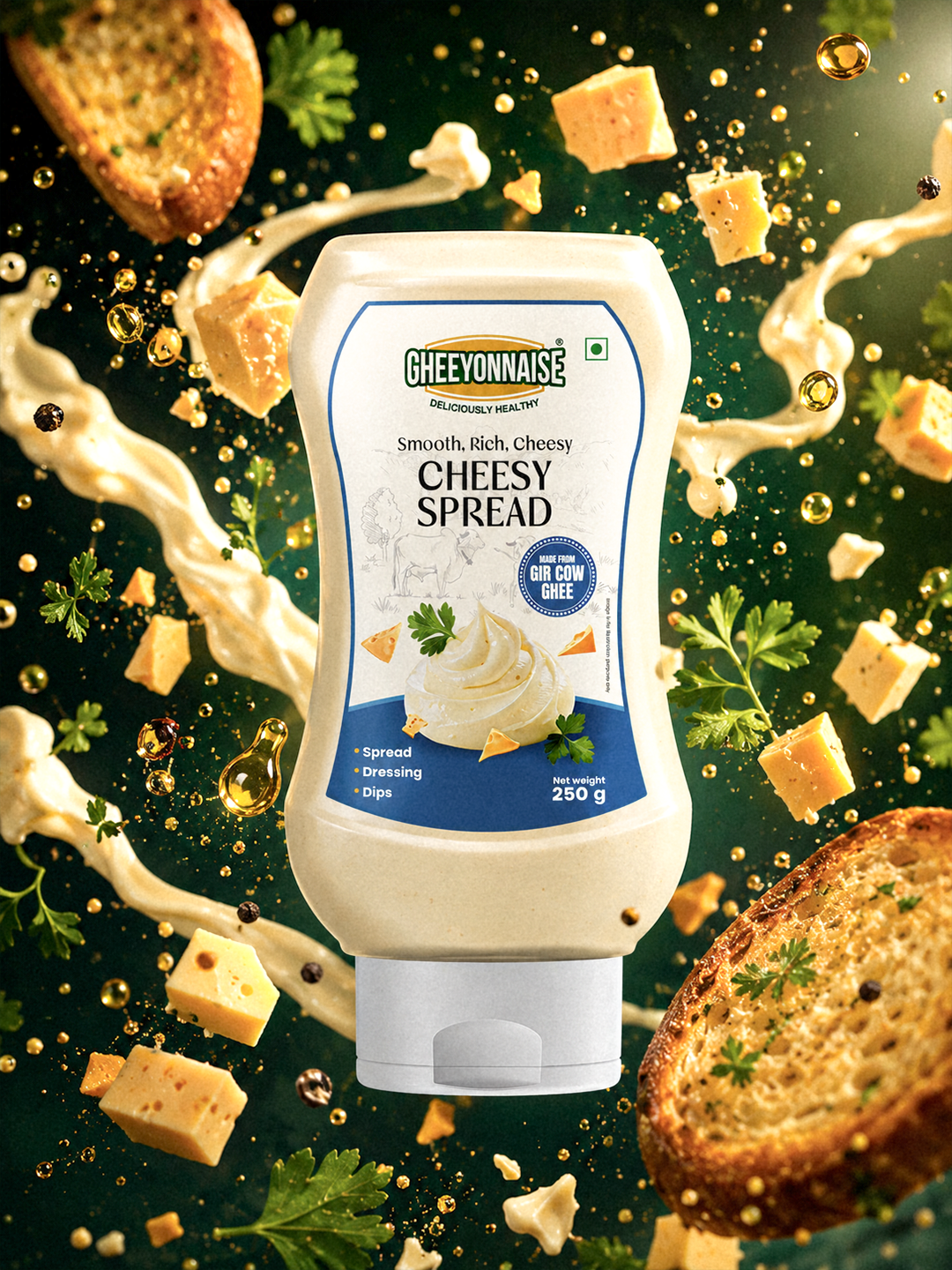
This history is also, plainly, why our products exist. We built a spread with A2 Gir cow ghee as its base rather than palm or soya oil because the substitution described above is still the default in most condiments on Indian shelves. You can see the full Gheeyonnaise range here.
Where Does This Argument Break Down?
The biggest limitation is that none of this is a health claim. Demonstrating that Indians used ghee for four thousand years says nothing about how much of it you should eat in 2026, and I'd be misusing the history if I implied otherwise.
The conventional view also holds in one important respect: ICMR-NIN's 2024 guidance capping visible fat at 27–30 g a day is current, evidence-reviewed, and applies regardless of how old the tradition is. Evidence on ghee and cardiovascular outcomes remains mixed, and I'm not going to pretend it's settled in our favour.
Where I could be wrong: it's possible the price story and the health story were more entangled through the 1960s and 1970s than the timeline suggests. The 1937 launch clearly predates the saturated-fat era. The 1980s decline of vanaspati probably doesn't.
This article is educational and not medical advice. Ghee is high in saturated fat and calorie-dense. Consult your healthcare provider for guidance specific to your health.
Frequently Asked Questions
How old is ghee in India?
The earliest direct chemical evidence of dairy processing in South Asia comes from Kotada Bhadli in Kachchh, Gujarat, at a settlement occupied between 2300 and 1950 BCE (Scientific Reports, 2020). Ghrita appears in Vedic ritual texts and is described as a daily rasayana in classical Ayurvedic literature, giving ghee a documented Indian history of roughly four thousand years.
Why did Indians switch from ghee to vanaspati?
Price and availability, not medical advice. Dalda launched in 1937 as an affordable, sealed, ghee-like alternative at a time when desi ghee was costly and loose ghee was often adulterated (Dalda, brand history). It dominated the category for decades. Saturated-fat concerns entered Indian public-health messaging much later.
Was vanaspati actually worse than ghee?
On trans fat, yes — substantially. India's food regulator has noted TFA content in vanaspati could reach 50–60% of total fat, while the WHO recommends trans fat stay below 1% of daily energy (FSSAI). India capped industrial trans fat at 2% in all fats and oils from January 2022. Modern compliant vanaspati is a different product from its mid-century version.
Is ghee making a comeback in India?
Yes, and fastest at the premium end. India's overall ghee market is projected to grow at 7.70% a year to 2034, while the A2 ghee segment is forecast to grow at 21.41% over the same period, from INR 1.28 billion in 2025 to INR 9.51 billion by 2034 (IMARC Group, 2025). The growth is concentrated in traceable, breed-specific ghee.
Conclusion: Four Thousand Years, One Interruption
Ghee didn't lose an argument in India. It lost a price war, and it lost it to a product whose main innovation was looking like ghee for less money.
What deserves to change is how we talk about this. Framing the vanaspati decades as a scientific correction gives an advertising campaign credit it never earned, and it teaches Indian consumers to distrust the wrong thing. The useful lesson isn't "traditional fat good, modern fat bad" — it's that a substitution sold on price and packaging deserves harder questions than a food with four thousand years of continuous use behind it.
The pots in Kachchh outlasted the tins. That's worth remembering the next time something on a shelf promises to be just like ghee.
"My grandfather sold ghee by weight to people who knew exactly what they were buying. Somewhere between his shop and my factory, we convinced an entire country that the tin was more trustworthy than the ghee. Getting that trust back is the work."
- Kehul Shah, Founder, Gheeyonnaise
Next, read A2 Ghee vs Regular Ghee: The Complete Gir Cow Comparison to understand what the modern premium segment is actually selling, or Is Ghee Healthy? What Science Says in 2026 for where the evidence currently stands.

0 comments